Movement, Focus, and Climbing: Therapeutic Benefits of Rock Climbing for Children with DCD
What is Developmental Coordination Disorder (DCD)?
DCD is a neurological condition that affects motor skills and coordination, making even simple movements feel like insurmountable challenges.DCD is often diagnosed at 5 years of age, including the 4 of the 5-DSM Criterias listed below: 1
- Motor coordination skills below level of expected age, difficulties manifesting as clumsiness (eg., dropping or bumping into objects) and slowness and inaccuracy of performance of motor skills (eg., catching an object, using cutlery and scissors, riding a bike, handwriting)
- Motor skill difficulties significantly interfering with activity of daily living (ADLs), impacting academic/school productivity, leisure, and play
- Onset of symptoms began in the early developmental period
- Motor skill difficulties that cannot be explained by other conditions (eg., intellectual disability or other neurological conditions that affect movement)
A Closer Look Through Movement
Flashed. You’ve just watched a youth climber – maybe roughly half your age or even younger – gracefully scaling your challenging rock climbing project on their first attempt. Every move seemed instinctive – hands gripping holds with precision, feet pressing against the wall at just the right angles, their body moving in harmony with the climb. It was a display of natural motor skill development at its finest. Yet, for many children with Developmental Coordination Disorder (DCD), this kind of fluidity, motor planning, and confidence in physical tasks is far from effortless.
Personal Insights: DCD and Attention-Deficit/Hyperactivity Disorder (ADHD)
DCD often coexists with ADHD. As a child, I was not diagnosed with DCD, but I can recognize similar patterns. I was noticeably clumsier than my peers – tripping over my own feet, struggling to throw a frisbee or ball straight, and frequently knocking things over without meaning to. My hypermobility made things even trickier, as my joints were overly flexible, making it hard to control my movements with precision. Whether it was stumbling while walking or misjudging where my body was in space, coordination and proprioception were constant challenges for me.
It wasn’t until later that I was diagnosed with ADHD, which helped explain my restlessness. I remember being constantly on the move, unable to sit still for even a moment. My endless supply of energy coupled with my lack of coordination skills drove my parents insane. According to Dannemiller et al., it is common to experience cognitive and motor skill difficulties, as both conditions affect the brain’s ability to plan and process movement with spatial awareness.1 It’s like trying to bowl with a lightweight ball on a slippery lane without bumpers.
As I grew older and began seeking ways to manage both my coordination challenges and mental restlessness, I discovered one activity that unexpectedly addressed both: Rock Climbing. It became more than a sport – it offered structure, sensory feedback, and mental focus in a way that nothing else had. To explain how climbing helped me, let’s revisit the bowling analogy I mentioned earlier.
| “Challenges” | Rock Climbing | |
|---|---|---|
| Lightweight ball | Hypermobility and proprioceptive challenges not providing enough weight or feedback to feel stable and in control | Increases proprioceptive feedback and control of one’s body (eg., constant leaning/proprioception into my body’s weight through the various holds) |
| Slippery Lane | Difficulty with coordination and focus, increased intentionality effort needed to stay on course | Fun form of aerobic exercise and general physical activity to enhance cognitive executive function |
| Bumpers | Failure to throw the ball in a straight line without bumpers | With bumpers: increases somatosensory input coupled with visual input that allows for feedforward control and motor planning |
Rock climbing transformed those challenges by providing a natural environment that encouraged movement, sharpened focus, and complex problem-solving. Rock climbing can be considered to be a full body workout requiring: 2
- specific grip strength for various holds
- power and coordination for dynamic precise explosive moves
- flexibility to perform high heel rock overs
- endurance to climb multiple routes
- motor planning skills
Next, let’s dive a little deeper into the research behind rock climbing and proprioceptive feedback, motor learning skills (via the cerebellum), and cognitive executive function.
Proprioception, Motor Learning (Cerebellum), and Rock Climbing
Proprioception “Lightweight Ball”
As a climber, you rely on proprioception to sense where your arm and hand are in space relative to the wall. When reaching for a hold you cannot see, your body may intuitively adjust the position of your shoulder, elbow, and wrist to make the grab. This is proprioception in action: awareness of body position and movement and encoding spatial information through internal sensory feedback – all without visual guidance.6
Your muscles contain mechanoreceptors that sense stretch (via muscle spindle receptors) and compression (via Golgi tendon organ receptors) that send sensory input to the brain. In contrast to my “lightweight ball” analogy, rock climbing involves continuous bouts of isometric forearm and muscle contractions throughout. This offers immense stretch and proprioceptive input through the joints, often providing more stability and spatial information for someone who is hypermobile like myself. 6 You might be wondering how we can use this increased sensory feedback in motor learning – that’s where the cerebellum comes into play!
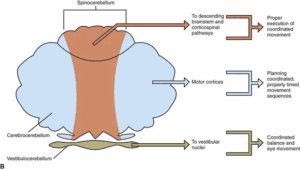
Cerebellum’s role in Proprioception: “Bumper”
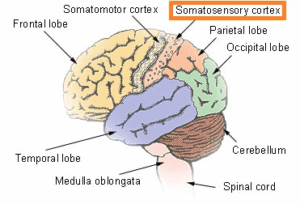
When we consider spatial awareness and coordination, the parietal lobe and cerebellum both play a role in sensorimotor prediction.2 The parietal lobe plays a crucial role in processing sensory information and proprioception.
Subsequently, the cerebellum of the brain also plays an important role in movement coordination and motor learning. Specific subregions of the cerebellum serve different functions: the “vestibulocerebellum coordinates eye movements and balance, spinocerebellum coordinates postural adjustments and ongoing movements, and the cerebrocerebellum coordinates the planning and initiating of movements”.2, 5
Now, if we think back to my bowling analogy, the “bumpers” are like the rock climbing holds that provide sensory feedback. When a climber is on the wall and releases a hold, they are required to equally distribute their weight on the remaining holds, counteract the perturbations via isometric contractions.2 If they do not successfully distribute their weight or grasp onto the hold, they may or may not slip – an error has been made. As they continue to practice by visually scanning, physically reaching, and making adjustments, they are able to successfully complete the move. This concept of using sensory feedback to correct movements is called feedback control.5 Using error-based feedback to fine-tune motor performance is a key component of motor learning – an area where research can help us understand what’s happening at the neurological level.
In an article by Di Paola et al, the authors looked at the positive effects of rock climbing on learning-induced neuroplasticity and motor learning. With the convergence of vision and proprioception, they work in parallel to predict the movement and monitor to make necessary adjustments, which updates my feedback control. Over time, with the learned adjustments, I rely less on feedback control and rely more on my feedforward control to make a movement more smoothly and accurately.2 As someone who is hypermobile and may have difficulties with coordination and spatial awareness, rock climbing has allowed me to learn how to make rapid movements without needing as many sensory feedback adjustments over time – improving my feedforward control!
Key Points 2, 5, 6
- Proprioception in Climbing: Climbers rely on proprioception to sense limb position and adjust movements without visual input—especially when reaching for unseen holds
- Mechanoreceptors at Work: Muscle spindle receptors (stretch) and Golgi tendon organs (compression) send continuous sensory feedback during isometric contractions in climbing, enhancing joint stability and spatial awareness—especially beneficial for hypermobile individuals.
- Cerebellum & Coordination: The parietal lobe and cerebellum collaborate to process proprioceptive input and coordinate movement; different cerebellar regions manage balance, posture, and motor planning.
- Sensory Feedback as “Bumpers”: Like bowling bumpers, climbing holds provide feedback. Errors (e.g., slipping) trigger real-time corrections via feedback control, improving performance with practice.
- From Feedback to Feedforward: Over time, climbers transition from relying on feedback to feedforward control, enabling faster, more efficient movement through neuroplastic changes—especially impactful for those with coordination difficulties.
Cognitive Benefits of Rock Climbing
Literature defines rock climbing as a combination of strength, endurance, and high-intensity aerobic exercise.2 Leading neuroscientists have connected aerobic exercise with increased working memory and cognition, but have yet to consider the effects of resistive-type training.3 Little research exists on rock climbing – a sport that includes both aerobic and resistive type training – and its specific effects on cognitive function for individuals with DCD or ADHD. There is some evidence stating similar types of exercise, such as Taekwondo (TKD), have been proven to be effective not only for coordination and motor planning but also influential on attention.1, 4 Personally, I have found rock climbing to be a fun form of exercise and has immensely allowed me to improve my attention and concentration. With these gaps in the literature, more research on the positive effects of rock climbing on executive function may be warranted to better understand its potential as a therapeutic intervention.
Rock Climbing as a Therapeutic Approach for DCD
As a therapeutic intervention, rock climbing offers a dynamic and engaging approach that addresses both motor and cognitive functions. Let’s first begin by reviewing current research on physical therapy interventions for individuals with DCD.
Breaking it down: Part by Part 1
According to the updated Physical Therapy Management of Children with DCD: Clinical Practice Guideline (CPG) in 2020, researchers report strong supporting evidence suggesting the use of task-oriented interventions in combination with body function and structure interventions for improving motor performance in individuals with DCD.
Task-Oriented interventions are motor activities or programs to improve the acquisition and execution of a specific motor task.1 They include:
- Motor skill training (Strong Evidence)
- Neuromuscular task training (Strong Evidence)
- Cognitive Orientation to daily Occupational Performance (Moderate Evidence)
- Motor Imagery (Moderate Evidence)
Body Function and Structure Interventions utilize a bottom-up approach, focusing on the body system impairment (muscle or joint level) to build a foundation for higher motor tasks. They include: 1
- Core Stability Training (Moderate Evidence)
- Cardiorespiratory Training (Moderate Evidence)
- Functional Movement-Power Training Program (Moderate Evidence)
CPG Main Points 1
If we consider rock climbing as an intervention, it encompasses a little bit of all the interventions mentioned above. But how can we apply these training interventions to rock climbing? Below are a couple main points from the CPG that may be beneficial to consider for individuals with DCD. These main points consist of facilitating self-discovery, practice using part-task training, feedback provision, multiple repetitions, adaptations, and variable environments. It’s important to note that individuals with DCD may experience greater challenges with these skills than their peers. We can draw parallels from each main point and connect it to an example of learning how to perform a rock climbing “dyno movement” – a common term for a controlled explosive full-body leap to reach a faraway hold.1
Facilitating Self-Discovery
- Main point:
- Allowing learned errors to be made, promoting self-confidence and problem solving
- How to apply it in rock climbing:
- Imagine a child with DCD is learning how to perform a vertical dyno. They may have unsuccessful attempts, prompting them to problem solve how to successfully complete the movement.
- The CPG also recommends a combination of individual and small group sessions “to address individual goals and generalize skills with peers.” 1
- This could look like 4-6:1 or 2:1 for groups.1
Practice Using Part-Task Training
- Main point:
- Breaking down a more complex skill into smaller components
- How to apply it in rock climbing:
- Breaking down a dyno movement with task oriented interventions:
- Working on each part of the jump individually:
- Lowering phase
- Elevating phase
- Jumping phase
- Catch phase
- Working on each part of the jump individually:
- If we broke it down to a body function structure intervention, they may require increased lower leg strength and power to be explosive. This would include working on:
- Squatting and jumping
- Calf strengthening and vertical jump height
- Abdominal strengthening and stability exercises
- Breaking down a dyno movement with task oriented interventions:
Feedback Provision
- Main Point:
- Both intrinsic and extrinsic feedback to help facilitate learning and improve performance
- How to apply it in rock climbing:
- Intrinsic feedback: one’s own sensory feedback
- (eg., feeling that they jumped up close to the wall or away from the wall)
- Extrinsic feedback: feedback from an external source, like a physical therapist
- (eg., verbal cues from the physical therapist to lead with their chest, hoping to have the individual jump closer to the wall rather than out)
- Intrinsic feedback: one’s own sensory feedback
Multiple Repetitions
- Main Point:
- Consistent practice and repetition is important for motor learning of a new skill followed by whole-task practice
- How to apply it to rock climbing:
- As for appropriate intervention dosage, the CPG also moderately recommends a “high frequency practice schedule of 2 to 5 times per week should be distributed among physical therapy sessions and other practice opportunities, until the goal task is achieved”.1
- Given all the feedback and practice, it all boils down to the individual practicing with multiple repetitions. For an individual with DCD, repetition at each stage of learning a task is beneficial for reinforcing their learned skills.1 As they feel more confident and achieve each part-task skill, they can continue to practice it all together (whole-part training).
Adaptation
- Main Point:
- Adapt and increase challenge of training based on progress
- How to apply it to rock climbing:
- With the individual now able to perform the dyno movement succinctly, therapists can increase the challenge by finding similar routes with dynos to practice on. This could also mean the patient increasing their strengthening parameters (increasing weights, repetitions, and time to perform exercises) when targeting a body function and structure impairment (eg., squatting, lifting). This increases their ability to adapt to similar dyno movements that they previously learned.
Variable Environments
- Main Point:
- Task-specific practice in different environments to promote transfer of knowledge of learned skill
- How to apply it to rock climbing:
- Now it’s time to try a dyno movement on a different route and incline! The individual has hopefully learned how to successfully perform a dyno that may require more vertical jumps; now they can transfer their knowledge of a more vertical jump dyno to another dyno that may require more up and backwards jumping. They may need to repeat this entire process a couple of more times with the new added jump challenge, or not!
Key Points 1
- Rock climbing aligns with evidence-based interventions for DCD: task-oriented and body function/structure interventions recommended in the Clinical Practice Guideline (CPG) for treating children with DCD
- Rock climbing promotes problem solving and self-discovery: learning a dyno movement through trial and error, building confidence, supporting executive function and motor planning – important skills for children with DCD
- Utilizing part-task training: breaking climbing movements into smaller components, such as phases of a dyno jump; strengthen specific areas, such as core or leg power, before combining movements together
- Encouraging intrinsic and extrinsic feedback with repetition for motor learning: intrinsic- own body awareness, extrinsic – verbal cues with repetitive practice for skill acquisition and retention for motor tasks in DCD)
- Progression and skill transfer through adaptation: increasing climbing difficulty and introducing different environments, allowing children to apply learned skills across different every day activities
Conclusion
One of my favorite places is the rock climbing gym. It feels like a playground full of fun puzzles to solve through various movements. For children with DCD, rock climbing may serve as an effective supervised therapeutic intervention, promoting body awareness through enhanced proprioception, improving rhythmic coordination, and supporting executive function skills. The role of the physical therapist may be to help guide children to safely participate in rock climbing, especially when considering individuals with other comorbidities such as hypermobility and ADHD.1 With proper modifications and support, climbing as a physical therapy intervention can offer a motivating, structured, and skill-building environment that challenges both the body and mind – helping children translate those gains into everyday functional tasks and social participation. Climb on!
Implications for Further Research
- Further research may benefit from looking at rock climbing and its effect on increasing proprioception and executive function in children with DCD.
- The CPG also recommends developing “standardized methods for documenting intervention dosages and clarify the optimal dosages for combined task-oriented and body functions and structures interventions that result in long-term motor performance improvements, accounting for motor impairment severity or diagnostic status of at risk for versus diagnosed DCD.” 1

Author Bio
My name is Sabrina Hung and I am a third-year Doctor of Physical Therapy student at University of Southern California (USC). Sabrina has a background as a former cross country and track & field hurdler, personal trainer, and assistant pastry chef. She quickly discovered her love for climbing during her time as a student. You’ll usually find her either studying at a coffee shop or in a study room — or splitting her time between studying and climbing at the gym! Her current interests in physical therapy include pediatrics and climbing related injuries.
For more information or to chat, reach out via email: sabrina.hung038@gmail.com or via instagram: @akairingo.
References
- Dannemiller, Lisa PT, DSc, PCS; Mueller, Melinda PT, DPT, PCS; Leitner, Adrah PT, DPT, PCS; Iverson, Erin PT, DPT, PCS; Kaplan, Sandra L. PT, DPT, PhD, FAPTA. Physical Therapy Management of Children With Developmental Coordination Disorder: An Evidence-Based Clinical Practice Guideline From the Academy of Pediatric Physical Therapy of the American Physical Therapy Association. Pediatric Physical Therapy 32(4):p 278-313, October 2020. | DOI: 10.1097/PEP.0000000000000753
- Di Paola M, Caltagirone C, Petrosini L. Prolonged rock climbing activity induces structural changes in cerebellum and parietal lobe. Hum Brain Mapp. 2013;34(10):2707‑2714. doi:10.1002/hbm.22095
- Huberman A, D’Esposito M. Dr. Mark D’Esposito: How to Optimize Cognitive Function & Brain Health [podcast]. Huberman Lab; February 19, 2024. Podcast episode. Available at: https://www.hubermanlab.com/episode/dr-mark-desposito-how-to-optimize-cognitive-function-brain-health.
- Kadri A, Slimani M, Bragazzi NL, Tod D, Azaiez F. Effect of Taekwondo Practice on Cognitive Function in Adolescents with Attention Deficit Hyperactivity Disorder. Int J Environ Res Public Health. 2019 Jan 12;16(2):204. doi: 10.3390/ijerph16020204. PMID: 30642062; PMCID: PMC6352161.
- Leech K. PT 569: Fundamentals of Neuroscience – Cerebellum. Presented at: University of Southern California Division of Biokinesiology and Physical Therapy; Year unknown. Lecture PowerPoint.
- Sugi T, Nițu A-M, Ishihara M. The effect of simulating climbing movements on rock memory and exploratory movement in rock climbing. Percept Mot Skills. 2022;129(3):528-553. doi:10.1177/00315125221093909.
- Lobes of the brain [image]. Study.com. https://homework.study.com/cimages/multimages/16/lobes4300195402801125246.jpg.
- The Cerebellum [image]. Veterinary Key. https://veteriankey.com/the-cerebellum/.
- Disclaimer – The content here is designed for information & education purposes only and the content is not intended for medical advice.
Related Posts