Test Your Climbing Movement: 5 Challenges from The Resilient Climber
Climbing is not just about finger strength. It is a full-body sport that requires mobility, strength, control, endurance, and the ability to move well in awkward positions.
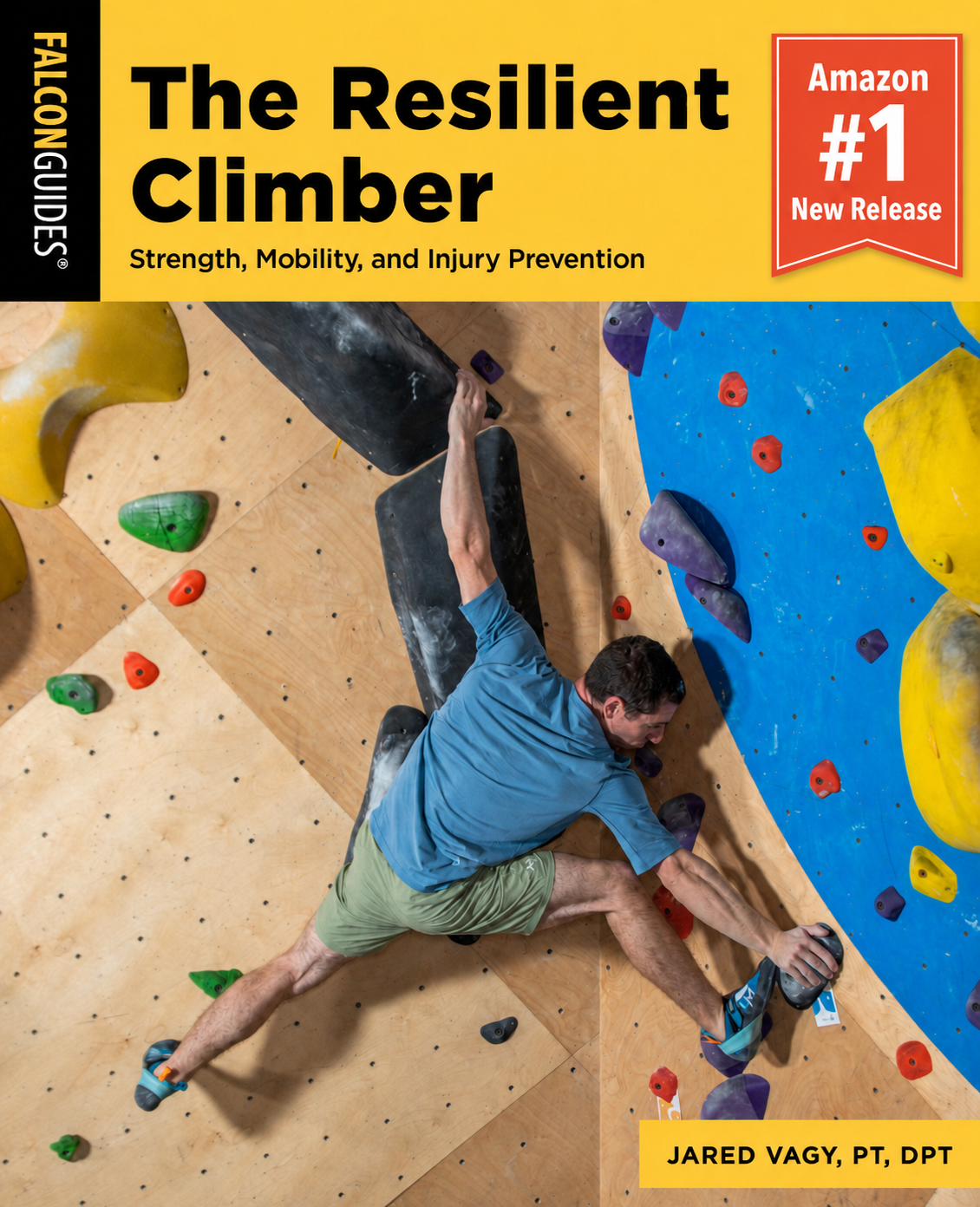
In this article, you will learn five simple movement challenges adapted from The Resilient Climber: Strength, Mobility, and Injury Prevention. Each one connects to a key climbing movement: high stepping, stemming, belaying, crimping, and lock-offs.
The goal is not to prove whether you are “good” or “bad” at climbing. There is a lot of individual variation based on height, limb length, climbing style, injury history, training background, and body type. A boulderer, trad climber, sport climber, and new climber may all score differently for completely valid reasons.
Use these challenges as a fun way to see where you currently stand, compare your results with other climbers, and identify which movement qualities may be worth training next.
Time and Equipment Needed
These five challenges are simple to set up and can usually be completed in 20 to 30 minutes, including setup and testing. If you include a full warm-up, plan for about 30 to 45 minutes total.
You will need
- A wall
- Tape measure
- Smartphone (timer and calculator)
- Pull-up bar
- Hangboard, campus rung, or sturdy edge
Optional
- Tape
- Bathroom scale, if using the scale-based crimp test
A partner is helpful for measuring and timing, but several tests can also be done on your own with a phone timer and careful setup.
How to Use These Tests
Before starting, warm up for 10 to 15 minutes with easy movement, light mobility, and a few progressive climbing-specific drills.
For each challenge:
- Test both sides when applicable (crimp and high step) and divide the total score by 2 for an average
- Record your score.
- Compare your results to the reference values.
- Retest after several weeks of training.
- Focus more on progress than perfection.
These tests are most useful when they help guide your training, not when they become a competition by themselves.
Challenge 1: High-Step Challenge
Adapted Grant Foot Raise
What It Tests:
- This challenge evaluates how high you can lift your foot into a high-step position. It gives you a simple way to assess hip mobility and your ability to bring the foot high while staying close to the wall.
How to Perform It
- Stand facing a wall with your feet shoulder-width apart and your toes about 9 inches, or 23 cm, from the wall. Place your palms on the wall at shoulder height, slightly wider than shoulder-width apart.
- Place a strip of tape vertically on the wall from your hands down toward the floor, or imagine a straight vertical line. Drag your big toe up the wall along that line, bending your knee and lifting the hip as high as possible.
- You may bend your standing leg or rise onto your toes if needed. The challenge ends when you cannot lift your foot higher or when your palms pull away from the wall.
- Have a partner mark the highest point reached by your big toe. Perform three repetitions on each side and average the results.
- Test both sides and divide the total score by 2 for an average.
Equipment
- Wall, tape, tape measure, calculator if normalizing your score.
Scoring
- Record your best average height in centimeters or inches.
- Measure leg length from the ASIS, the bony landmark at the front of the pelvis, to the bottom of the medial malleolus, the bony bump on the inside of the ankle.
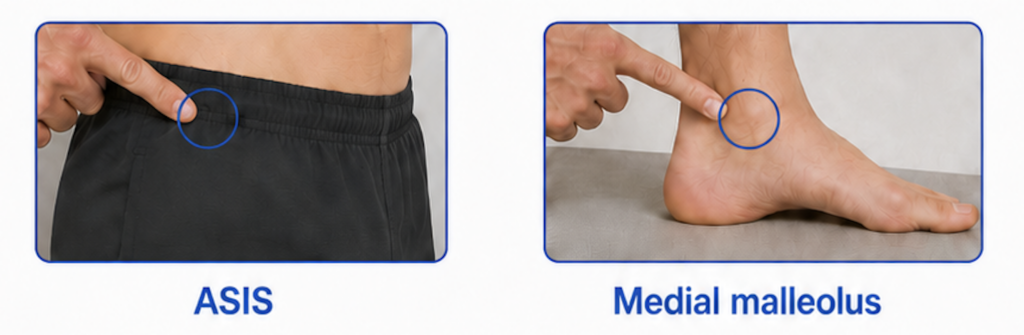
Normalized High-Step Score = foot height ÷ leg length × 100. For example, if your foot reaches 110 cm on the wall and your leg length is 89 cm: 110 ÷ 89 × 100 = 124% This means your high-step height is 124% of your leg length.
| Score (Points) | Average Percentage |
|---|---|
| 1 | Less than 114% |
| 2 | 114% to 118% of leg length |
| 3 | 119% to 123% of leg length |
| 4 | 124% to 128% of leg length |
| 5 | 130% of leg length or higher |
Reference values: Novice: 103.7 cm / 40.8 in; Intermediate: 102.4 cm / 40.3 in; Advanced: 108.3 cm / 42.6 in; Elite: 114 cm / 44.9 in.
Draper, Nick, Simon Brent, Chris Hodgson, and Gavin Blackwell. “Flexibility Assessment and the Role of Flexibility as a Determinant of Performance in Rock Climbing.” International Journal of Performance Analysis in Sport. 9, no. 1 (2009): 67–89.
Challenge 2: Stemming Challenge
Straddle Stand
What It Tests
- This challenge measures hip abduction mobility, which is the ability to move the legs apart. This is especially relevant for stemming, wide bridging positions, and any move that requires the hips to open away from the midline.
How to Perform It
- Stand with your feet wide and move into a side split position while keeping your feet flat on the ground. Go as low as you can while maintaining control.
- Have a partner measure the vertical distance from your groin, near the lower edge of the pubic bone, to the floor while you are in the straddle stand position. A lower number indicates that you are closer to the ground and have more available hip abduction range.
Alternate Version: Straddle Sit
- You can also perform this test seated with your legs in a wide straddle and your feet against a wall. This version is easier to measure by yourself, but it also includes more hamstring flexibility, so it may be slightly less specific to standing stemming positions.
Equipment
- Tape measure.
| Score (Points) | Average Distance |
|---|---|
| 1 | 55 cm / 21.7 in or higher |
| 2 | 45 to 54 cm / 17.7 to 21.3 in |
| 3 | 35 to 44 cm / 13.8 to 17.3 in |
| 4 | 25 to 34 cm / 9.8 to 13.4 in |
| 5 | Less than 25 cm / 9.8 in |
Reference values measured from Pubic Bone: Straddle Stand mean: 38 cm, range: 11 to 53 cm. Straddle Sit mean: 44 cm, range: 13 to 55 cm.
Draga, Paweł, Mariusz Ozimek, Marcin Krawczyk, Robert Rokowski, Marcelina Nowakowska, Paweł Ochwat, Adam Jurczak, and Arkadiusz Stanula. “Importance and diagnosis of flexibility preparation of male sport climbers.” International Journal of Environmental Research and Public Health 17, no. 7 (2020): 2512.
Challenge 3: Belay / Chin Tuck Challenge
Chin Tuck Hold Test
What It Tests
- Belaying often requires looking up for long periods, especially without belay glasses. This position can place repeated demand on the neck.
- The Chin Tuck Hold Test assesses deep neck flexor endurance, which can be important for neck comfort and control.
How to Perform It
- Lie on your back with your knees bent and feet flat on the floor.
Tuck your chin as much as possible, like making a double chin. Then lift your head and neck until the back of your head is about 1 inch, or 2.5 cm, off the ground. - Have a partner time how long you can hold the position. They can place a hand under your head without letting your head rest on it.
- Stop the timer when your chin untucks or the back of your head touches your partner’s hand for more than one second.
A few notes
- Look at the scoring systems beforehand and don’t always go for “maxing out” to save energy (and your neck)
- Quality matters almost as much as hold time. It is common for the chin to untuck slightly during the test, even by an inch or two. If that happens, the test is over. The head must stay about 1 inch off the ground, and the chin must remain fully tucked throughout the entire hold. If you are scoring greater than one minute on this challenge, have your partner watch closely to make sure your chin stays fully tucked the entire time.
Scoring
- Record your hold time in seconds.
| Score (Points) | Average Time |
|---|---|
| 1 | Less than 15 seconds |
| 2 | 15 to 24 seconds |
| 3 | 25 to 34 seconds |
| 4 | 35 to 39 seconds |
| 5 | 40 seconds or more |
Reference values: Men: 39 seconds; Women: 29 seconds.
Domenech, Manuel A., Phil S. Sizer, Gregory S. Dedrick, Michael K. McGalliard, and Jean-Michel Brismee. “The Deep Neck Flexor Endurance Test: Normative Data Scores in Healthy Adults.” *Physical Medicine & Rehabilitation Journal* 3, no. 2 (2011): 105–10.
Challenge 4: Crimp Challenge
Crimp Strength Test
What It Tests
- This challenge measures how much force you can produce through a crimp grip. It can be performed using a campus rung, hangboard, or doorframe with a bathroom scale. The preferred depth to standardize the assessment is roughly a fingertip-pad edge depth.
- This is a strength test, so warm up thoroughly before attempting it. Do not perform this test if you currently have finger pain or an active finger injury.
How to Perform It
- Stand on a bathroom scale underneath a campus rung, hangboard edge, or sturdy doorframe.
- Using one straight arm, gradually pull down on the edge and see how much weight you can remove from the scale. Progressively increase your effort until you reach your maximum voluntary force.
- Hold the position for three to six seconds.
- If the scale reaches zero because you are fully hanging from the edge, you have maxed out the test scoring. However, it can still be useful to understand your crimp strength more precisely. To continue testing, you can add weight by holding a dumbbell or kettlebell in your opposite hand, or switch to a smaller edge size and repeat the test.
- Test both sides and divide the total score by 2 for an average
Your score is: Body weight − weight remaining on the scale = crimp force. For example, if you weigh 160 lb and the scale reads 60 lb during your max effort, your score is 100 lb.
Equipment
- Campus rung, hangboard, or doorframe; bathroom scale.
Research Based Method with Scale
| Score (Points) | Average Score |
|---|---|
| 1 | Less than 35 kg / 77 lb |
| 2 | 35 to 42 kg / 77 to 93 lb |
| 3 | 43 to 46 kg / 95 to 101 lb |
| 4 | 47 to 50 kg / 104 to 110 lb |
| 5 | 51 kg / 112 lb or higher |
Reference values: Lower: 35 kg / 77 lb left, 39 kg / 86 lb right; Intermediate: 43 kg / 95 lb left, 45 kg / 99 lb right; Advanced: 46 kg / 101 lb left, 50 kg / 110 lb right; Elite: 51 kg / 112 lb left, 54 kg / 119 lb right.
Draper, Nick, David Giles, Nicola Taylor, Laurent Vigouroux, Vanesa España-Romero, Jiří Baláš, Ignacio Solar Altamirano, et al. “Performance Assessment for Rock Climbers: The International Rock-Climbing Research Association Sport-Specific Test Battery.” *International Journal of Sports Physiology and Performance* 16, no. 9 (2021): 1242–52.
Alternate Method Without a Scale
-
If you do not have a bathroom scale, you can score the Crimp Challenge by performing a two-arm bodyweight hang on a roughly a fingertip-pad edge. Use a half-crimp grip. Keep both hands on the edge, your arms straight or slightly bent, and your feet off the ground. Stop the timer when your fingers open, your feet touch the ground, or you can no longer maintain the grip position.
Body Weight Method
| Score (Points) | Average Score |
|---|---|
| 1 | Unable to hold body weight on the edge |
| 2 | 1 to 5 seconds |
| 3 | 6 to 10 seconds |
| 4 | 11 to 20 seconds |
| 5 | More than 20 seconds |
Challenge 5: Lock-Off Challenge
Lock-Off Until Failure
What It Tests
- This challenge measures bent-arm pulling endurance and lock-off capacity. It is relevant for moves where you need to hold tension, pause in a bent-arm position, reach with the opposite hand, or control your body close to the wall.
How to Perform It
- Set up under a pull-up bar. Pull yourself into a two-arm lock-off position with both elbows fully bent.
- To make the test more consistent, use a box or chair to get into the starting position so you do not waste energy pulling up.
- Once you are in position, hold as long as possible while keeping your body steady and both arms engaged.
- Stop the timer when you can no longer maintain the position.
Equipment
- Pull-up bar, step or webbing (optional)
Testing Note
| Score (Points) | Men: Hold Time | Women: Hold Time |
|---|---|---|
| 1 | Less than 20 seconds | Less than 10 seconds |
| 2 | 20 to 34 seconds | 10 to 19 seconds |
| 3 | 35 to 51 seconds | 20 to 29 seconds |
| 4 | 52 to 64 seconds | 30 to 39 seconds |
| 5 | 65 seconds or more | 40 seconds or more |
Reference values: Men: average 51.8 seconds, range 19 to 90 seconds; Women: average 25.05 seconds, range 3 to 56 seconds.
Mermier, Christine M., Jeffrey M. Janot, Daryl L. Parker, and Jacob G. Swan. “Physiological and Anthropometric Determinants of Sport Climbing Performance.” *British Journal of Sports Medicine* 34, no. 5 (2000): 359–65.
Total Resilience Score
Use this scoring system to calculate your total score across all five challenges. This is meant to be fun and useful, not definitive. Scores will vary based on body size, climbing discipline, injury history, and training experience.
Scoring System
| Score (Points) | Average Percentage |
|---|---|
| 1 | Less than 114% |
| 2 | 114% to 118% of leg length |
| 3 | 119% to 123% of leg length |
| 4 | 124% to 128% of leg length |
| 5 | 130% of leg length or higher |
| Score (Points) | Average Distance |
|---|---|
| 1 | 50 cm / 19.7 in or higher |
| 2 | 40 to 49 cm / 15.7 to 19.3 in |
| 3 | 30 to 39 cm / 11.8 to 15.4 in |
| 4 | 20 to 29 cm / 7.9 to 11.4 in |
| 5 | Less than 20 cm / 7.9 in |
| Score (Points) | Average Time |
|---|---|
| 1 | Less than 15 seconds |
| 2 | 15 to 24 seconds |
| 3 | 25 to 34 seconds |
| 4 | 35 to 39 seconds |
| 5 | 40 seconds or more |
| Score (Points) | Research-Based Method with Scale | Bodyweight Method |
|---|---|---|
| 1 | Less than 35 kg / 77 lb | Unable to hold body weight on the edge |
| 2 | 35 to 42 kg / 77 to 93 lb | 1 to 5 seconds |
| 3 | 43 to 46 kg / 95 to 101 lb | 6 to 10 seconds |
| 4 | 47 to 50 kg / 104 to 110 lb | 11 to 20 seconds |
| 5 | 51 kg / 112 lb or higher | More than 20 seconds |
| Score (Points) | Men: Hold Time | Women: Hold Time |
|---|---|---|
| 1 | Less than 20 seconds | Less than 10 seconds |
| 2 | 20 to 34 seconds | 10 to 19 seconds |
| 3 | 35 to 51 seconds | 20 to 29 seconds |
| 4 | 52 to 64 seconds | 30 to 39 seconds |
| 5 | 65 seconds or more | 40 seconds or more |
Add your five challenge scores together.
| Score | Results |
|---|---|
| 5–9 | Foundation Builder |
| 10–14 | Movement Apprentice |
| 15–19 | Well-Rounded Climber |
| 20–23 | Movement Specialist |
| 24–25 | Resilient Climber |
What Your Score Means
A high score does not guarantee that you will climb hard, and a lower score does not mean you cannot climb well. Climbing performance depends on technique, tactics, power, endurance, mental skills, recovery, experience, and movement efficiency.
But these five tests can help you identify useful patterns.
- If your high-step score is low, you may benefit from hip mobility and high-step control work.
- If your stemming score is low, you may need more hip abduction mobility.
- If your chin tuck hold is limited, neck endurance may be worth addressing, especially if you belay often.
- If your crimp score is low, finger strength may be a limiter, but it should be trained gradually.
- If your lock-off score is low, bent-arm pulling endurance and shoulder blade control may be worth developing.
Train the Movements
Want to improve any of these five challenges and the climbing movements they support? Take your climbing further with targeted exercises, mobility and strength training, and practical movement tips from The Resilient Climber resources.
- The Resilient Climber Book gives you the full framework for understanding the strength, mobility, and movement capacity behind key climbing techniques.
- The Resilient Climber Videos provide a guided exercise library with detailed demonstrations, coaching cues, and common mistakes to avoid.
- The Resilient Climber Course gives you a structured program to apply the concepts, choose focus areas, and build resilience over time.

- Disclaimer – The content here is designed for information & education purposes only and the content is not intended for medical advice.
Related Posts