Simple, yet Meaningful Effects of Bouldering on Mental Health
In a world where mental health challenges are increasingly prevalent, finding effective, accessible, and sustainable ways to improve well-being is more important than ever. Exercise has long been recognized as a powerful intervention—not only for physical health but also for mental resilience. Moving the body improves mood, sharpens focus, fosters social connection, and helps combat the feelings of isolation and helplessness that often accompany anxiety and depression. Among the many forms of physical activity, rock climbing stands out as a uniquely beneficial pursuit. Combining physical exertion, problem-solving, mindfulness, and social interaction, bouldering engages both body and mind in ways that directly counteract the core symptoms of mental health struggles. This paper explores how bouldering offers more than just a workout; it provides purpose, connection, and empowerment, making it a compelling and research-supported strategy to improve mental health, particularly in young adults.
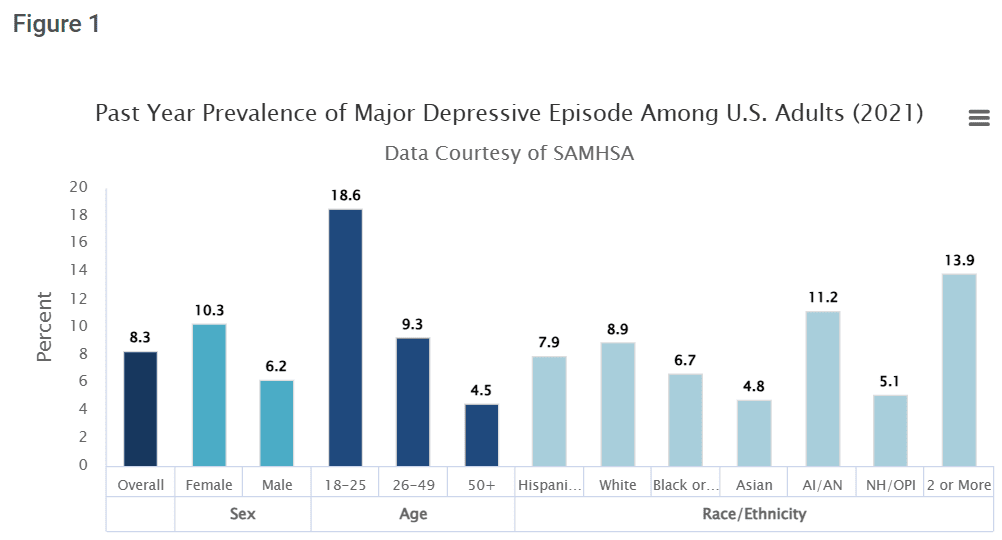
Mental health has affected today’s culture significantly. There is a likelihood that each of us have either struggled with moments of depression and anxiety, and if not us, then surely close friends and family. Specifically, the population of 18-25 year olds in America, are at highest risk of Major Depression, exemplified by the figure below:
Furthermore, “psychological distress” was found in 41% of American adults, most of whom still fit in the college to post graduate demographic.
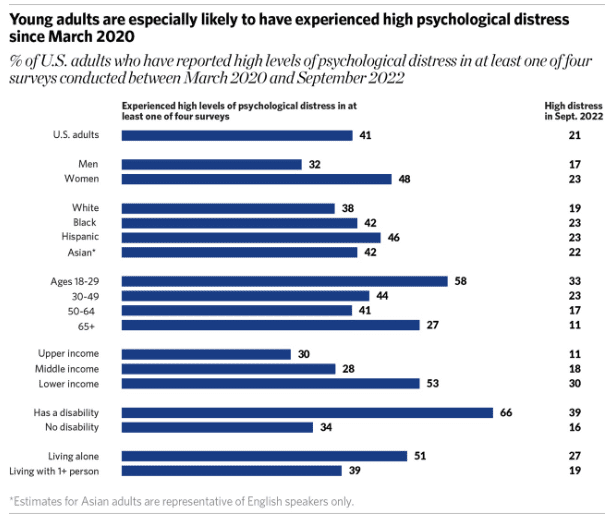
Though mental health is no respecter of persons, young adults in college and right after college are susceptible to these struggles. Whether it may be that it is more culturally acceptable to talk about mental health, or if the ever changing landscape of technology has affected the current growing generations, there is no doubt that these struggles are prevalent and real.
One treatment option that is affordable and accessible is exercise. General physical activity has been shown to offer the benefits of cognitive enhancement such as distraction from negative thoughts and feelings, regaining a sense of purpose, improved performance on tasks involving executive control and perception, enhanced physical and global self-esteem, higher quality of life, and improved coping strategies2. The Centers for Disease Control and Prevention (CDC) suggest that 150 minutes of moderate activity (most commonly, brisk walking) a week is a great start to cardiovascular exercise1. Another study found that those who did no physical activity at all were twice as likely to suffer from symptoms of poor mental health than those who are engaged in regular physical activity2. A step further than the classic 150 minutes of moderate exercise a week would be to be involved in a sort of group exercise to combat mental health struggles. Anxiety and depression frequently tell us that we are alone and by ourselves. Recreational group activities provide important social opportunities to combat what our brains can tell us at times.
One popular recreational activity that is becoming more prevalent today is bouldering. Bouldering can be generally defined as rock climbing with no harness to various heights with sufficient safety mats on the ground. I will present some anecdotal thoughts as to why I believe that bouldering is such a great way to combat mental illness and then finish with thoughts more so supported by research on why it has been shown to be a meaningful way to combat mental illness.
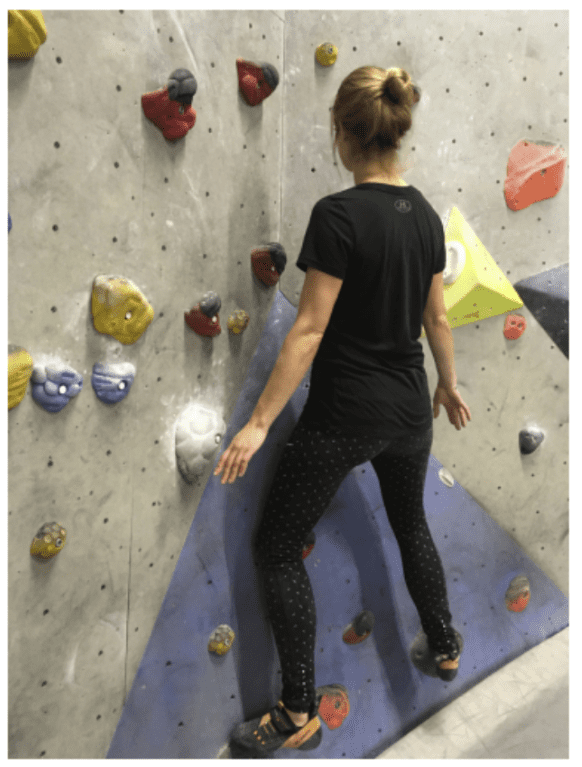
Regarding depression, I have seen many who are close to me become crippled by the weight of being alone and having no purpose. In bouldering, the goal is to reach the finish.This combat, even if for a moment, the intruding thoughts of having no purpose as you are given a task to do. With anxiety, I have seen in myself and many of my peers throughout my time in college worry about the future. A large part of Cognitive Behavioral Therapy (CBT), the strategy used in talk therapy sessions, is the idea of mindfulness. This is focusing on where we are at now and becoming aware of thoughts as well as sensations in our body. Furthermore, you are forced to be aware of where each limb of your body is on the wall and how they are being used. Mindfulness is being taught, even if it’s informal, as shown as the balance exercise in the following picture.
Only at rare times are bouldering gyms empty. Often times there are others around who are also solving problems and are happy to chat if the time is right. Strategies and experiences on the bouldering wall can be shared, and a sort of social interaction occurs. This is a core part of healthy human flourishing, as explained in The Anxious Generation by Jonathan Haidt3. This book proposes the idea that our phones are not only correlated, but casusitive, of the mental illness epidemic in developed countries. In a gym with a normal amount of climbers, the environment. forces the climber to not spend so much time on their phones, but to be aware of what is happening in the moment. More often times then not, people are willing to give advice and cheer you on as you challenge yourself. The environment and experience of a bouldering gym can be addicting. There are routes for all levels of fitness so that your level experience is not a barrier.
There is a reality that therapy and drugs are a huge change that mentally can feel like a big step to try. For the person who is not ready for each of those, the research would support that moving your body is a great step to lower the symptoms of mental health struggles. For those who are ready for a bigger step, a group activity such as bouldering would be a great place to start. It allows us to form organic social interactions, and it gives us problems and goals.
CBT is a very common way that mental health therapists are treating the brain and its cognitive functions in their patients. In a similar vein, Bouldering Psychotherapy (BPT) is becoming a way in which mental health therapists in combination with physical therapists can provide a body-based intervention for those who struggle with mental health. BPT is a way in which participants can practice the concepts learned in CBT such as self-efficacy, problem solving, and exposure training, right then and there with bouldering. One author notes that “BPT should not be seen as a different therapy but as an enrichment and implementation of CBT methods on the bouldering wall7.” The group session focuses not only on bouldering, but it typical has a curriculum that educates the participants on healthy thinking patterns. In one study, researchers discovered that BPT is just as effective as CBT or an at home exercise program (EP), if not better.
Another study focused on the idea of perceived self efficacy, which is defined as “people’s beliefs in their capabilities to perform difficult or novel talks to obtain desired outcomes.5” Those who struggle with mental health generally have low self perceived efficacy. In bouldering, it is not a team sport in which others can carry the load for you. When one finishes a route, it is solely because you were able to physically do it. This is a huge step forward for someone who feels like they cannot function by themselves. The image below shows that though all patients increased from baseline at the end of 10 weeks, only BPT and CBT scored “normal” or healthy.” It is to be noted that a generalized exercise program (EP) is helpful, but it was not as helpful as BPT or CBT according to this study, most likely due to the lack of psychoeducation that occurs with these studies.
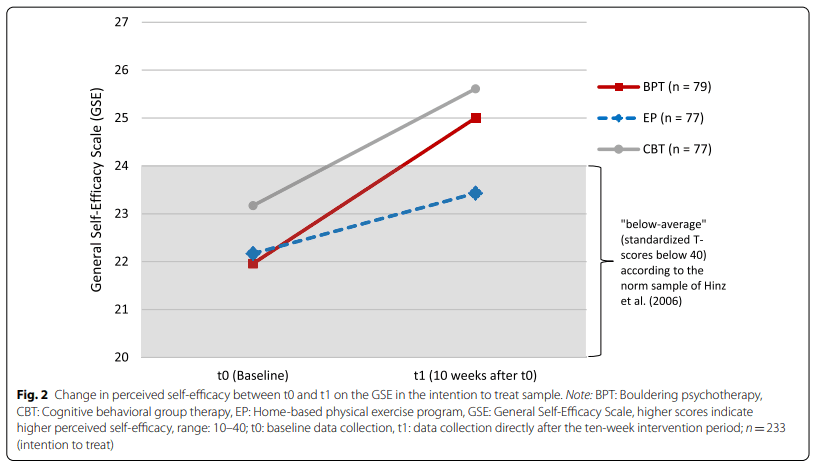
The study continues to report that there is no significant difference between the increase in scores in BPT and CBT, which shows that though it should not be a sole substitute, there are clear benefits of BPT for those who have self diagnosed themselves with mental health struggles5.
There is sufficient evidence to show that there is great benefit to BPT. It is better than exercise alone and its outcomes can be similar to CBT. In conclusion, bouldering offers a unique, accessible, and effective avenue for addressing mental health challenges, particularly for young adults grappling with depression and anxiety. Its inherent structure—encouraging mindfulness, fostering social interaction, and promoting a sense of achievement—aligns with proven therapeutic strategies like CBT while providing the added benefits of physical exercise. Whether approached as a recreational activity or as part of a structured treatment plan, bouldering empowers individuals to build resilience, improve self-efficacy, and cultivate mental well-being.
I’ve been through many seasons of fitness — running, weightlifting, CrossFit — but recently I’ve found myself in a season of bouldering. What started as a spontaneous outing with friends about a year ago turned into something much more meaningful. At first, I struggled. I wasn’t good, and honestly, it felt too hard to commit to. But over time, I kept showing up — partly to spend time with my friends, partly to move my body intentionally, and eventually because I started to really enjoy the challenge. Bouldering has been a steady anchor for me during a tough year of physical therapy school and preparing for boards. It’s given me a way to challenge myself physically and mentally, while also celebrating small victories and building resilience. The mix of problem-solving, strength, and persistence that bouldering demands has helped me feel more confident and connected to my body. For anyone reading this, I encourage you to give it a shot. You don’t need to be good when you start — none of us are. What matters is showing up, trying again, and noticing your progress over time. Whether you’re looking for community, stress relief, or just a fresh challenge, bouldering offers all of that and more. So grab some shoes, step on the wall, take a chance, and see where it takes you!

Author Bio
Kevin Pham is a Doctor of Physical Therapy passionate about movement, resilience, and helping others. He resides in Gainesville, Florida where he just graduated in May of 2025 from the University of Florida with his Doctor of Physical Therapy degree. With a background in running, weightlifting, CrossFit, and now bouldering, he understands the mental and physical challenges that come with pursuing fitness in different seasons of life. Kev combines his clinical expertise with personal experience to encourage others to find joy and purpose in movement — no matter where they’re starting.
References
- Centers for Disease Control and Prevention. (n.d.). Physical activity guidelines for adults. Retrieved from https://www.cdc.gov/physical-activity-basics/guidelines/adults.html
- De Mello, M. T., de Aquino Lemos, V., Antunes, H. K. M., Bittencourt, L., Santos-Silva, R., & Tufik, S. (2010). Relationship between physical activity and depressive symptoms in adults: A review. American Journal of Preventive Medicine, 38(2), 173–178. https://doi.org/10.1016/j.amepre.2009.08.029
- Haidt, J. (2024). The anxious generation: How the great rewiring of childhood is causing an epidemic of mental illness. Penguin Press. Retrieved from https://www.penguinrandomhouse.com/books/729231/the-anxious-generation-by-jonathan-haidt/
- Karg, N., Dorscht, L., Kornhuber, J., & Luttenberger, K. (2020). Bouldering psychotherapy is more effective in the treatment of depression than physical exercise alone: Results of a multicentre randomised controlled intervention study. BMC Psychiatry, 20, 116. https://doi.org/10.1186/s12888-020-02518-y
- Karg, N., Dorscht, L., Kornhuber, J., & Luttenberger, K. (2021). Bouldering psychotherapy is effective in enhancing perceived self-efficacy in people with depression: Results from a multicenter randomized controlled trial. BMC Psychology, 9, 1612. https://doi.org/10.1186/s40359-021-00627-1
- Stelzer, E. M., Book, S. W., Graessel, E., & Hofmann, H. (2018). Bouldering psychotherapy reduces depressive symptoms even when general physical activity is controlled for: A randomized controlled trial. Frontiers in Psychology, 9, 1612. https://doi.org/10.3389/fpsyg.2018.01612
- Disclaimer – The content here is designed for information & education purposes only and the content is not intended for medical advice.
Related Posts