Neuromuscular Re-Education of the Finger Flexors
You stick the crux crimp on your project. It’s the hold. Your fingers wrap perfectly around each ridge but, as you start to lock off, your pinky peels off.
Instantly, the position changes because of this unwanted move and the hold feels smaller while the lock-off feels harder.
You try again next burn. Same thing. Again. And again. So what gives?
- Is it a strength problem?
- Do you just need a stronger three-finger drag?
- More time on the hangboard?
- Harder crimps?
Maybe. But not always.
Sometimes the issue isn’t how much force you can produce. It’s how your nervous system chooses to produce it. Your brain loves efficiency and over time, it wires in patterns that feel automatic—like subconsciously dropping a pinky and defaulting to a three-finger drag. That pattern might have worked before or even feel comfortable due to habit. But on this hold, on this move, it’s costing you. This is where neuroplasticity comes in.
Neuroplasticity, the brain’s ability to rewire itself and make new synaptic connections, means your movement patterns aren’t fixed. Through high-frequency, high-repetition practice, you can retrain your nervous system to hold the position you actually want. Instead of reacting automatically, you choose the grip. You own the grip. Because even if you’re strong enough to readjust mid-move, that micro-hesitation drains energy, it disrupts rhythm, and it chips away at precision. At your limit, small inefficiencies become the difference between sticking the move and taking the fall.
Integrating neuromuscular re-education with traditional finger strength training has the potential to elevate your climbing beyond strength alone. It’s not just about producing more force—it’s about producing the right force, at the right time, in the exact position you intend. Stronger fingers help. But fingers that fire exactly how you tell them to?
That’s how you send.
So, based on research describing the importance of neuromuscular control (Carter and al. 2025) and the well-studied gains seen with hangboard training, training both together could potentially maximize your climbing.
Why hangboard and train all the fingers if not to use them on a climb?
Why Should You Do Neuromuscular Rehab?
Here are some signs and symptoms that you might need it:
- You can’t maintain your intended grip position.
You hit the hold right… but within seconds your pinky drops, your thumb shifts, or your open hand goes morpho. You didn’t choose to change it — it just happened. - You’re constantly readjusting mid-move.
Bump. Re-squeeze. Micro-shift. Every adjustment costs time and tension. On hard terrain, that hesitation is the difference between flow and failure. - Certain fingers feel “offline.”
One digit won’t engage. One hand feels less coordinated. You struggle to apply even pressure across all fingers, especially on small edges. - Your force output feels inconsistent.
You know you’re strong enough because you’ve tested it with your Tindeq and trained it through hangboarding and pulls. But on the wall, force production varies from attempt to attempt. Some burns feel solid while others feel weak or “off”.
Neuromuscular re-education targets the communication between your brain and your fingers. It improves motor unit recruitment, coordination between digits, and your ability to maintain a specific joint position under load. Instead of defaulting to the most familiar or energy-efficient pattern, you retrain your system to hold the exact grip you choose with cleaner movement.
Assessment
Considering the signs and symptoms above, assessment for several of those can be completed as follows:
1. Loss of Desired Grip Position
What we’re testing:
Joint mobility and positional motor control under load
- Assess MCP, PIP, and DIP flexion/extension of each digit.
- Compare sides.
- Look for stiffness, asymmetry, or limited end-range control (especially pinky DIP/PIP).
Limited ROM may force compensatory grip changes.
- Actively form the intended grip (e.g., open-hand crimp).
- Hold for 10–15 seconds without resistance.
- Watch for pinky drop, DIP hyperextension, or loss of uniform flexion.
If the position changes without load, this is motor control and not necessarily strength.
- Use a hangboard edge at submax intensity (50–60%).
- Maintain a specific grip position for 7–10 seconds.
- Film from the side.
Position breakdown under light load could indicate neuromuscular control deficits.
2. Finger Dexterity and Grip Re-adjustments
What we’re testing:
Finger proprioception, coordination and voluntary muscle recruitment
- Passively place a finger in ~70–80% flexion.
- Remove support.
- Try to reproduce the same position with eyes closed.
Large variability could indicate a decrease in joint proprioception.
- Grab a small edge.
- Count how many visible readjustments occur before settling.
- Compare dominant vs. non-dominant hand.
Multiple micro-adjustments could indicate decreased motor planning.
- Hand flat on table.
- Lift one finger at a time without others moving.
- Compare excursion and smoothness side to side.
Poor isolation could indicate a motor control deficit or lack of conscious engagement.
The Rock Rehab Pyramid
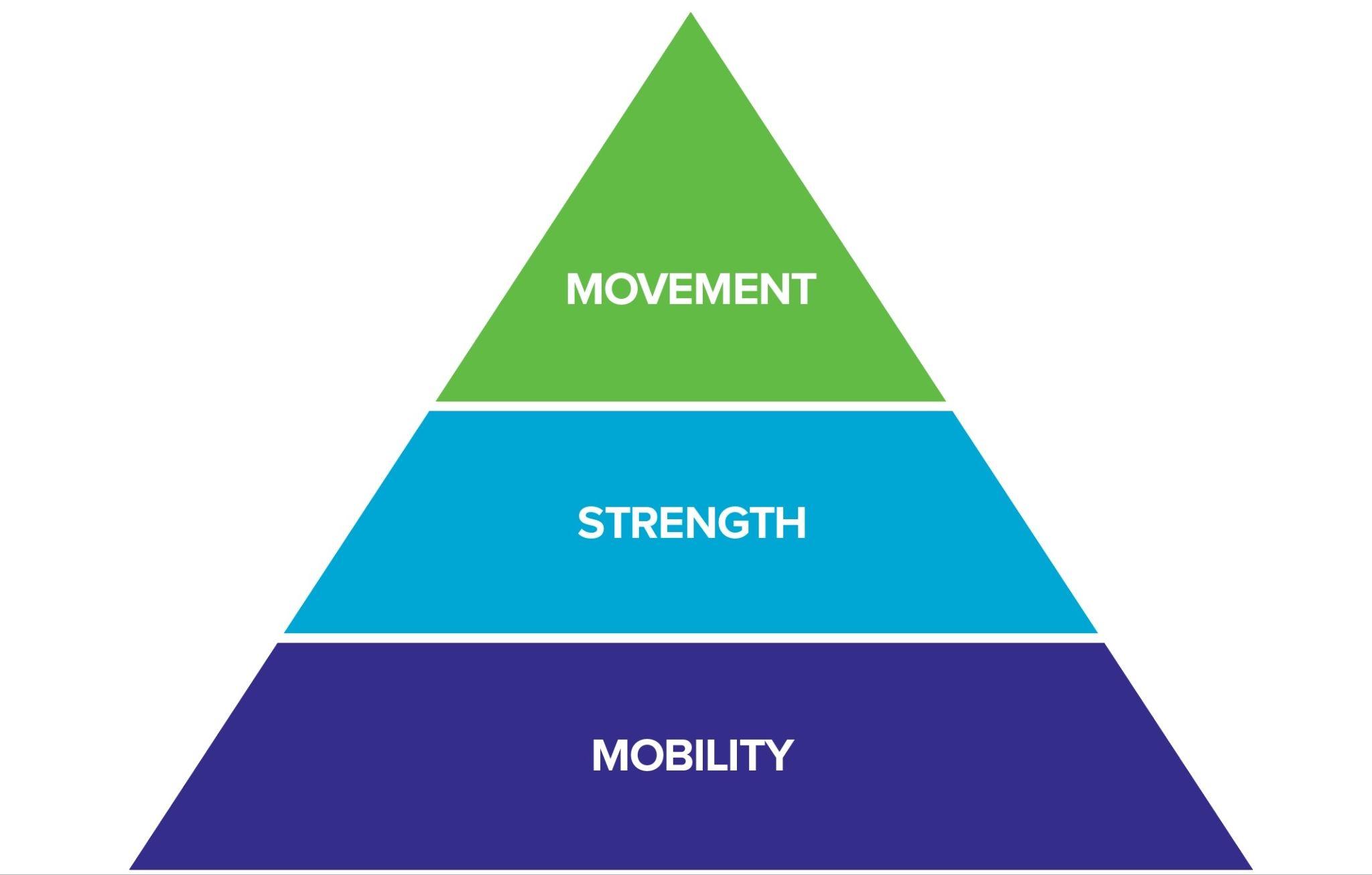
The Rock Rehab Pyramid is a four-phase injury rehabilitation and prevention system for climbers created by Dr. Jared Vagy (The Climbing Doctor) in his book Climb Injury-Free. The phases progress from pain management (unloading) to mobility, strength, and finally movement, helping climbers recover and climb stronger. The system treats specific injuries but we’ll use it here to classify different neuro-muscular rehab exercises. And since we’re not injured but are focusing on movement efficiency, we won’t be unloading.
Here, Exercise #1 is for mobility, Exercises #2-3 are movement based exercises and #4-7 are strength based exercises.
Finger Active Range of Motion
First, let’s train finger mobility. As climbers, tight muscles can be found all over the body, but can also be found in the extrinsic or intrinsic muscles of the hand. Your nervous system can only reinforce positions it can physically access. If joint motion is limited, the brain repeatedly selects the path of least resistance like a compensated pattern (like dropping the pinky into a three-finger drag). Over time, that compensation becomes the default wiring. Limited range of motion narrows the movement solution space and when you restore mobility, you expand it.
1. Finger DIP Activation
(could use a video for that, other options : passive joint mobilization, finger stretches, intrinsic hand muscle massage, forearm muscle massage, etc…)
- Frequency: Multiple times a day
- Intensity: 1-3 RPE*
- Time: 25+ reps
- Type: Neuromuscular re-education
*What is RPE?
It stands for Rating of Perceived Exertion. For neuromuscular re-education, the subjective rate of how hard you are working should be fairly low. These exercises are meant to retrain your body to move a different way and while it may be mentally fatiguing and you may be using your muscles in ways they are not accustomed to, these should not be making you break a sweat.
2. Deadpoints Holds
For this neuromuscular rehab exercise, after your warmup, find a climb with a deadpoint move, whether it be on your favorite training board or on the gym bouldering set, and complete the move ensuring that you maintain contact with all fingers on the hold. Repeat.
- Frequency: After your warm-up
- Intensity: 3-4 RPE
- Time: 10+ reps each hand, less than 45 second break in between
- Type: Neuromuscular re-education
3. Two Move Sequences
Similar to the purpose and protocol for the Deadpoints Holds. For this next exercise, try two consecutive moves on comfortable holds first and then move to small holds if it’s too easy.
- Intensity: 2-4
- Time: 5+ reps each hand
4. Assisted Hang Isometrics
Many of us already spend time on the hangboard, so this may be a familiar exercise that we are going to follow with the intention to maintain the desired grip position.
- Frequency: Before your climbing session,
- Intensity: 1-4 RPE, 50-75% body weight on a 25 mm edge or less
- Time: 10 sec on each rep for 8-10 reps
- Type: Neuromuscular re-education
5. Assisted Isolated Finger Isometrics
Following the same protocol as the exercise above, increase the amount of assistance generously and train each individual finger (aside from the thumb) to isometrically hold the hangboard in desired position.
6. Weighted Hang Isometrics
Once you feel comfortable with maintaining quality hand positioning with assistance, reduce the amount of help and try isometric hangs with body weight and progressing to added weight. If finger compensation occurs, reduce the weight.
- Frequency: Before your climbing session, 3-5 reps
- Intensity: 3-5 RPE, body weight or more on a 25 mm edge or less
- Time: 7-10 seconds (ensuring you are maintaining a quality grip position)
- Type: Neuromuscular re-education training with strength
7. Offset Isometric Hangs
It is rare that in actual climbing, whether in the gym or outside, that our hands are perfectly aligned on the exact same size of hold. So, for this exercise, we are once again repeating the same idea as the Weighted Hang Isometrics but the hands will be offset and on different mm edges. For example, 30 mm and 18 mm edge.
- Frequency: Before your climbing session, 3-5 reps
- Intensity: 3-5 RPE, body weight or more
- Time: 7-10 seconds (ensuring you are maintaining a quality grip position)
- Type: Neuromuscular re-education training with strength
With all these exercises and movement strategies, the mind to muscle memory gained is aimed to adapt your brain to climb with you in control.
Experience it yourself
Since this specific topic of training neuromuscular re-education, specifically for grip style in climbing, does not have intensive research, I tried this protocol for myself to see what would happen. It is a self-experiment of one participant, but I added in my progressive videos so you all could take a look. I have been a chronic 3 finger drag climber, from jugs to crimps, and even pinches. For a while, I would tell myself that it was because of the length of my pinky compared to the others and it was my anatomy that preferred a 3 finger drag. That was until I started watching videos of myself climbing and realized that it may not be the case; my pinky would stay on, pop off, and would refuse to return. After hangboarding for several weeks and knowing all my fingers could work together and hold me up on various edges, I started to consider maybe I had built a habit of popping my pinky off at any chance.
Since beginning this blog article in the middle of fall 2025 (it is now the beginning of 2026), I began to implement these exercises into my climbing routine 3 times a week and saw a significant improvement in my ability to keep the grip I wanted.
Experience it yourself and let me know how it went!
Before videos:
After videos:
Experience it yourself and let me know how it went!

Author Bio
Bella Castro is a current second- year doctorate of physical therapy student at the University of Southern California. Bella began climbing after the COVID-19 pandemic and became engulfed in the community and culture in El Paso, Texas, with home crag being Hueco Tanks State Park and Historic Site. Other hobbies include figure skating, trail running, being outside, and glass-blowing.
To connect with author, email bellacastro528@gmail.com or connect through social media on Instagram via @bella.castro.
This article was written with mentorship support from Julien Descheneaux pht. MSc. through the Student Climbing Special Interest Group, a free program for student physical therapists to receive education and mentorship in the treatment of climbing-related injuries.
See a Doctor of Physical Therapy
Neuromuscular re-education is a facet of training that can be optimized by visiting a physical therapist to provide exercise programs, further education on the topic, and to provide qualitative measures of progress. Similarly, a physical therapist can utilize their knowledge of body mechanics to improve functional performance of your hands and the rest of your body on and off the wall.
References
- Carter DJ, Forsyth JR, Mattock JPM, Shemmell J. Neuromuscular control of a five-finger pinch task is influenced by training history. Exp Brain Res. 2025;243(10):205. Published 2025 Sep 2. doi:10.1007/s00221-025-07147-z
- Dindorf C, Dully J, Berger J, et al. Assessing the Impact of Neuromuscular Electrical Stimulation-Based Fingerboard Training versus Conventional Fingerboard Training on Finger Flexor Endurance in Intermediate to Advanced Sports Climbers: A Randomized Controlled Study. Sensors (Basel). 2024;24(13):4100. Published 2024 Jun 24. doi:10.3390/s24134100
- Kozin, Serhii et al. Journal of Physical Education and Sport; Pitesti Vol. 21, Published 2021 Apr. doi:10.7752/jpes.2021.s2159
- Levernier G, Laffaye G. Four Weeks of Finger Grip Training Increases the Rate of Force Development and the Maximal Force in Elite and Top World-Ranking Climbers. J Strength Cond Res. 2019;33(9):2471-2480. doi:10.1519/JSC.0000000000002230
- Watts, P. B., Jensen, R. L., Agena, S. M., Majchrzak, J. A., Schellinger, R. A., & Wubbels, C. S. (2008). Changes in EMG and Finger Force with Repeated Hangs from the Hands in Rock Climbers. International Journal of Exercise Science, 1(2), 62–70. https://doi.org/10.70252/EQEO5233
- Disclaimer – The content here is designed for information & education purposes only and the content is not intended for medical advice.
Related Posts