Hamstring Injury in Rock Climbers
You’re climbing your project, and you have a high heel hook set on a big hold. The next hold looks far but your heel feels secure so you pull on it hard, locking off on your hand holds. As you release one of your hands to reach for the next hold, you feel a sudden pop high in the back of your thigh and you release the tension on your heel causing you to fall. As you get up from the pads and start walking, you feel a sharp pain in the back of your thigh as you take each step forward. You have experienced a hamstring injury!

The hamstring muscle group is composed of three muscles in the back of the thigh. On the outside is the biceps femoris which is made up of a long and short head, and on the inside is the semimembranosus and the semitendinosus. The biceps femoris causes hip extension, knee flexion, and knee external rotation. The semitendinosus and semimembranosus cause hip extension, knee flexion and knee internal rotation. Heel hooking loads the hamstring because it requires both hip extension and knee flexion. While performing a heel hook, the knee is usually externally rotated, so the biceps femoris is especially loaded. Other aspects of climbing that load the hamstring muscle group include drop knees and climbing overhung walls.

Hamstring injuries vary in severity and are classified in three grades. A grade I injury is a minor muscle pull or strain. A grade II injury is a partial thickness tear of the muscle or tendon, and a grade III injury is a complete tear of the muscle or tendon. Another severe variation is an avulsion fracture which is when the tendon pulls a piece of bone from the muscle attachment. Hamstring injury can occur anywhere along the course of the muscle or tendon. Strains that occur closer to the attachment on the pelvis are associated with longer recovery. Without proper rehabilitation, hamstring injuries commonly return, so it is important to see a physician or physical therapist for proper assessment and care.
Signs and Symptoms
Signs and symptoms vary based on the severity of hamstring injury. Generally, symptoms will include localized pain, especially with stretching or activation of the hamstrings.
Grade I:
With a grade I hamstring injury, you will experience pain at the local site of injury, you may feel tightness or cramping in the back of the thigh, slight pain with stretching or activation, minimal strength loss, and stiffness that subsides with activity but returns after activity. With a grade I injury, you might continue to climb through the pain because once you warm up you stop noticing it, but heel hooks or overhang climbing still cause sharp pain. After climbing, the pain and stiffness returns.
Grade II:
With a grade II injury, you will experience pain in a larger area, difficulty walking especially one to two days after the injury, possible bruising, and greater stiffness, as well as more weakness and pain than with a grade I injury. You will notice this more throughout your day to day activities outside of climbing. If you try to climb shortly after this injury, it will cause more severe pain than with a grade I injury.
Grade III:
With a grade III injury, you will see large areas of bruising with swelling, there may be a palpable mass where the muscle tore, and you will have great difficulty with walking so you will probably be using crutches. Climbing with a grade III hamstring injury would be very difficult and you would notice significant weakness in the affected leg.
Assessment
For suspected grade III hamstring injuries, an MRI is usually used to determine if the tissue is completely ruptured. An X-ray may be prescribed if an avulsion fracture is suspected. For grade I and II injuries, imaging is not typically required, but rather, signs and symptoms and clinical assessments can be used to diagnose injury and functional impairments. Hamstring strength and flexibility are components that should be measured to compare to the unaffected leg and to track progress throughout rehabilitation.
A self-diagnostic test for a suspected grade I or II hamstring strain is the “taking off the shoe” test. In this test, you stand with both shoes on, then pull the affected shoe off with the arch of the other foot. If pain is provoked by this test, then it increases the suspicion that you experienced a hamstring strain. This action would cause pain to the injury because it requires activation of the hamstrings. This specifically tests for a strain of the biceps femoris because the knee is externally rotated which increases the load on the biceps femoris.


A strength assessment you can use to measure your hamstring strength is the single-leg bridge test. To perform this test, lie on your back on the ground with one leg propped on a bench, chair, or sofa. Perform as many single-leg bridges as you can. This can be used to reassess hamstring strength throughout your rehabilitation and to compare your progress compared to your other leg. This is important in determining when a return to climbing without limitation is appropriate.


A hamstring flexibility assessment you can use is the 90-90 active knee extension test. For this test, lie on your back with one leg flat on the ground and the other leg at 90 degrees of hip flexion and 90 degrees knee flexion. Then, while holding your hip at 90 degrees of flexion, straighten your knee as much as you can. You can use this to estimate how much your hamstring flexibility on the injured side is limited compared to your other leg. It is also a good tool to use in tracking progress in hamstring flexibility as you regain normal function.
Rehabilitation
Phase 1: Rest and Recovery
During the first 1-2 weeks of recovery, it is important to stop doing the activities that led to your injury. The severity of injury will determine how long you will need to take a break from climbing. You may need to avoid heel hooks and other provocative climbing movements for longer, but it is best to take a short break from climbing to avoid re-aggravating tissues that are in early stages of healing. The following are some things you can utilize in the meantime which can encourage the healing process and relieve some pain.
- Rest: Relative rest can be different depending on the severity of injury. For all grades of hamstring strain it is best to take a break from climbing. If you have a severe injury resulting in pain with walking, the use of crutches may be beneficial to unload the hamstrings.
- Ice: Apply ice to the site of injury for no more than 20 minutes at a time. Use a barrier over the skin to avoid damage to the skin.
- Hamstring roll out: Use a foam roll to gently massage the hamstrings for 2-5 minutes, 2-3 times a day. Load the hamstrings with moderate pressure, but avoid pain.


- Active range of motion: 3×30 seconds 3-5 times a day, move your knee from bent to extended position within a pain free range.


Phase 2: Mobility and Gentle strengthening
This phase focuses on regaining hamstring flexibility and introducing load to increase blood flow to the tissues, and start to strengthen the hamstrings without overloading them.
Hamstring stretch: Hold for 3×30 seconds 2-3 times a day. Stretches should cause a moderate stretching sensation, but should not provoke pain.
- Option#1: Lying on your back with your leg extended, use a sling, belt, rope, etc. around your foot to pull your leg up until you feel a moderate stretch in the back of your thigh. If you feel pain with this exercise, lower your leg until the pain subsides.


- Option #2: Start lying on your back with your hip and knee at 90 degrees. Actively extend your knee until you feel a moderate stretch in the back of your thigh. If you feel pain with this exercise, lower bend your knee until the pain subsides.


- Seated hamstring curl with elastic band: 3×20 repetitions. Attach one end of an elastic band to a stable object and the other end around your heel. In a seated position starting with your leg extended, pull your heel back.


- Bridges: 3×15 repetitions. Start lying on the ground with your knees bent. Then, lift your hips off the ground by fully extending at your hips.


Phase 3: Strengthening
This phase focuses on strengthening your hamstrings to prepare for the loads associated with returning to climbing. The following exercises progress in intensity and strengthen the hamstrings in increasingly lengthened positions. Even if you have not injured your hamstring, these exercises will strengthen your posterior chain muscles to improve your ability to climb overhanging terrain, heel hook effectively, and avoid future hamstring injury.
- Single leg bridges: 3x 8-12 repetitions. Perform a bridge in the same way as in the previous phase, except only use one leg. You can do this exercise on both your affected leg and your non-affected leg.


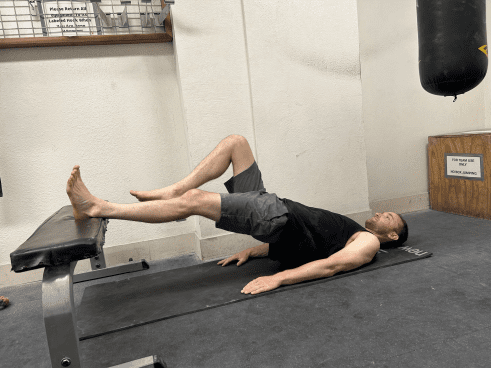
- Elevated bridges: 3x 8 to 12 repetitions. Start lying on your back with your feet elevated on a bench or chair. Extend at your hips contracting your hamstrings and glutes to lift your hips from the ground.
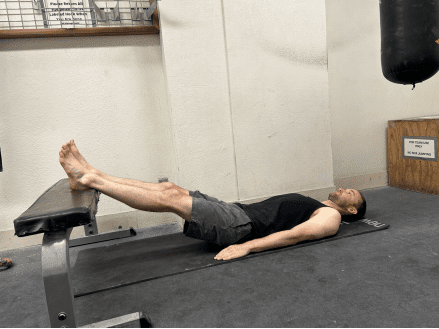

- Single Leg Elevated Bridges: 3x 8 to 12 repetitions. Repeat the same process as the previous exercise but use only one leg. Once again, do this on both sides!

- Straight leg deadlift: 3x 8 to 12 repetitions. Start with no weights to learn the movement and progress in weight according to ability. Maintain a neutral spine and allow slight bending at the knees. Descend until you feel a mild stretch in your hamstrings, then extend your hips to stand fully upright.


- Single leg straight leg deadlift: 3x 8 to 12. This exercise may challenge your balance, so make sure you are in an area free of obstacles for your safety. Initially try this without weights to make sure you can do it without losing your balance. Like the previous exercise, maintain a neutral spine and allow a slight bend in the knee. Descend until you feel a mild stretch in your hamstrings, then come back up into a fully upright position.


Phase 4: Return to Climbing
The final phase is returning to climbing. If your injury is minor, you will not need to wait until you complete all the previous phases to start climbing, but whenever you return to climbing, you should continue to avoid movements that aggravate pain. Examples of movements that can aggravate a hamstring injury are drop knees, climbing on overhanging walls, and especially heel hooking. In the meantime, you can develop skills you may be neglecting, like toe hooks! Before you return to climbing without limitation, you should reassess your hamstring strength and flexibility and compare it to your non-injured side. Perform the tests listed earlier to compare your performance. If they cause pain to return it is best to hold off on hamstring heavy movements like heel hooks. At this point, your injured side should be comparable to your non-injured side on the assessments you performed. Once your pain has subsided, any swelling and bruising is gone, and your hamstrings are stronger and more flexible, you can reintroduce previously aggravating moves into your climbing, but start gradually. For heel hooking, start in smaller ranges close to your body and over time progress to high heel hooks.


Conclusion
Hamstring injuries in rock climbers are common because climbing movements like heel hooks, drop knees, and climbing on overhung terrain place unique demands on the hamstring muscles. Understanding the anatomy, mechanisms of injury, and the differences between grades of strain is essential for proper recognition and management. With early identification, appropriate rehabilitation, and a gradual return to climbing, most climbers can recover fully and return to climbing harder than ever. Long-term success depends not only on healing the hamstring itself but also on building strength and flexibility and modifying technique when needed. By combining structured rehab with climbing-specific progressions, rock climbers can reduce the risk of reinjury and continue to climb stronger and more free of injury.
About the Author
Cameron Meteer is a Doctor of Physical Therapy in the Sacramento, CA area who graduated from the California State University-Sacramento DPT program in July of 2025. He enjoys surfing, rock climbing indoors and out and exploring new places with his wife. He is implementing his own advice as he is rehabbing a hamstring injury from heel hooking!
If you have any questions, contact him at: cameron.meteer@gmail.com


This article was written with mentorship through the Student Climbing Special Interest Group, a free program for student physical therapists to receive education and mentorship in the treatment of climbing-related injuries.
References
- Schöffl V, Lutter C, Popp D. The “Heel Hook”-A Climbing-Specific Technique to Injure the Leg. Wilderness Environ Med. 2016;27(2):294-301. doi:10.1016/j.wem.2015.12.007
- Martin RL, Cibulka MT, Bolgla LA, et al. Hamstring Strain Injury in Athletes. J Orthop Sports Phys Ther. 2022;52(3):CPG1-CPG44. doi:10.2519/jospt.2022.0301
- Ehiogu UD, Stephens G, Jones G, Schöffl V. Acute Hamstring Muscle Tears in Climbers-Current Rehabilitation Concepts. Wilderness Environ Med. 2020;31(4):441-453. doi:10.1016/j.wem.2020.07.002
- Zeren B, Oztekin HH. A new self-diagnostic test for biceps femoris muscle strains. Clin J Sport Med. 2006;16(2):166-169. doi:10.1097/00042752-200603000-00014
- Reurink G, Goudswaard GJ, Oomen HG, et al. Reliability of the active and passive knee extension test in acute hamstring injuries. Am J Sports Med. 2013;41(8):1757-1761. doi:10.1177/0363546513490650
- Disclaimer – The content here is designed for information & education purposes only and the content is not intended for medical advice.
Related Posts