Injury Prevention for Routesetters
Routesetters are an integral part of the indoor climbing community. Without them, we wouldn’t have fun, quality routes and problems to climb, and we’d eventually get a bit tired of climbing the same things in our gym over and over again! Additionally, routesetters have the important role of setting climbs that force us to learn new skills, which is a crucial part of progressing in the sport. Many routesetters work full time each week, climbing for many hours each day – much more than the average rock climber. While this may sound like the dream job to some people who just want to climb, it does take a toll on the body. As a result of the frequent, intense loads that routesetters put on their bodies, they are prone to developing less healthy relationships with climbing intensity and volume which can put them at a higher risk of developing overuse injuries compared to the general population. This article will talk about how to change habits, both at work and at home, to help keep routesetters healthy.
The Demands of the Job
While day-to-day demands can vary, a typical day for a routesetter looks something like the following:
When they arrive at the gym, routesetters must “strip” the wall. This is the process of taking down all of the holds that are already on the wall using an impact driver.
Next, they will set the “skeletons,” or rough drafts, of their climbs. Typically, one routesetter will set 40 to 60 feet of vertical terrain in a day. This could be one to three ropes, or three or more boulders.
The next step is forerunning, which involves high-volume climbing. They climb the skeletons and then make modifications to them, which often involves the setters trying variations of the same move many times in a row. This process, which can take many hours, puts repeated stress on the specific body structures involved with the move.
Finally, they end the day by set-screwing the holds to stop them from spinning, which is another repetitive task using an impact driver. They also must put away all of the ladders, spare holds, and any other equipment used that day.
This whole process involves lifting lots of heavy and awkwardly shaped objects. While some setting teams are able to use carts to transport large objects around the gym, sometimes carrying them is the only option.
While that makes up a typical day, some days or weeks might look different. First, the holds that were stripped need to be cleaned, which involves lifting and moving holds multiple times, putting heavy stress on the back. Additionally, a week will be different leading up to a competition. In these weeks, setters might spend a couple of days setting skeletons, followed by days in a row of mostly forerunning. The setting style for a competition can also differ dramatically, often demanding more dynamic movements that generate more impact and can put even more stress on the entire body.
For this article, I sent out a survey to routesetters in my region. Information collected included:
- Length of route setting career
- Days of route setting per week
- Hours of climbing outside of work per week
- Any traumatic injuries and their mechanism(s)
- Any overuse injuries and their mechanism(s)
- Warm up routine (if any) and how frequently it is performed
I received seventeen responses across four states. They have been setting an average of three and a half years, with the longest having been in the profession for fifteen years. Most set three to four days each week, with only two reporting setting five days out of the week. There did not seem to be a correlation between hours spent climbing outside of work each week and incidence of either traumatic or overuse injury.
Of the seventeen responses, twelve climbers reported having an established warmup that they performed before forerunning. However, only two individuals claimed to complete their warm up 100% of the time. On average, those who did warm up were only doing so for three out of five days of work. Of those who do warm up, the most common activities mentioned were hangboarding, shoulder and hip mobility, and cardiovascular warm ups (jumping jacks and hacky sack). Most people also mentioned that they start with the easier climbs to gradually increase the demands on their body.
Throughout this article, I will also be referring to a survey recently completed on the same topic by Dr. Evelyne Lajoie, a physical therapist who specializes in climbing-related injuries and has been very active with the climbing community in Canada. Her survey is linked at the end of this article.
Overuse Injuries Among Routesetters
Almost all participants in the survey (88%) reported experiencing overuse injuries at some point in their career, with multiple individuals describing nagging pains that they have been experiencing on and off for years.
The most commonly reported body parts to experience an overuse injury were fingers and shoulders with seven responses each. Five participants reported elbow pain, and three individuals said they had experienced wrist pain in their careers.
One individual noted nerve pain that ran down both arms and into their hands when they first started setting. Dr. Lajoie describes how the vibration of an impact driver can affect nerves and blood vessels, especially when used for longer periods of time. Wearing vibration-limiting gloves could help to decrease the risk of nerve issues happening among routesetters, especially in situations where they are using an impact driver for a longer duration, such as stripping a large portion of a gym to set for a competition.
Traumatic Injuries Among Routesetters
Traumatic injuries are not as common among routesetters compared to overuse injuries, but they do happen. In my survey, eight individuals (47%) had experienced a traumatic injury while on the clock. While there is limited data surrounding traumatic injuries among routesetters compared to overuse injuries, I found that ankles were the most commonly injured body part (three total injuries) followed closely by fingers. Dr. Lajoie found hands and fingers to be the body parts most susceptible to traumatic injuries (23 total injuries), followed by the ankle with 11 injuries.
All of the traumatic injuries reported in my survey happened during the forerunning process, meaning that the routesetters were climbing rather than putting holds on the wall or moving things around. The most common mechanisms reported that resulted in traumatic injuries were (1) falls, (2) crimping, and (3) heel hooking. While it is harder to completely prevent injuries from a fall, a proper warm up could help to decrease the risk of traumatic injuries. The next section will focus primarily on what routesetters could do to decrease their likelihood of experiencing overuse injuries.
Injury Prevention
One of the most effective ways to decrease your risk of getting injured at work is to take a short, 10-15 minute break between setting the skeletons of your climbs and forerunning to perform a climbing-specific warmup. Putting holds on the wall is a good aerobic warm up–it can start to elevate your heart rate, start pumping more blood around your body, and get your muscles in a better state to try hard–but it is still important to do a more climbing specific warm up where you gradually load your joints, tendons, and muscles.
While each warm up should be specially tailored to each routesetter’s needs, such as paying extra attention to a body part that is known to experience injuries, there are also general exercises that can and should be performed by each routesetter prior to starting the forerunning process. They are listed below in order from the body part that was most commonly injured to the least. All of these exercises should be performed slowly and with control. You can adjust any weights as needed, but keep in mind that these should not be performed at your maximum difficulty. The last reps of each exercise can be slightly challenging, but you should still feel like you could do more reps.
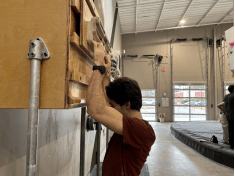
1. Fingers: Gradual Load Hangboarding
With feet on ground, start on part of the hangboard where you can comfortably fit two pads of each finger (excluding the thumbs). Sink your hips and knees down until you are putting enough weight through your fingers that you can feel them working. Hold for 10 seconds, then ease back off. Perform three sets of this exercise, then repeat with a one-pad edge and finally a half-pad edge.
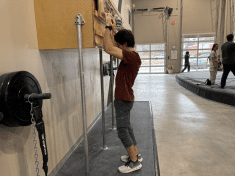
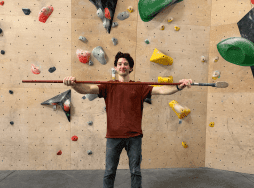
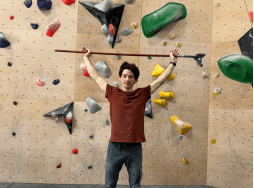
2. Shoulders: Overhead Shoulder Mobility
Hold a stick brush (or PVC pipe) horizontally in front of your body. Bring the brush up and over your head, ending in the position shown in the second picture. Keeping your body upright, pull to the left with your left hand, then come back to center and pull to the right with your right hand. Perform 10 repetitions of this exercise, making sure to come back to the starting position each time. You may need to increase or decrease how far overhead you go to feel an optimal stretch.

3. Elbow: Weighted Pronation and Supination
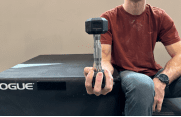
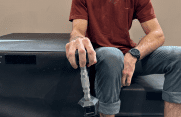
Holding the end of a five pound dumbbell, sit up straight with your forearm supported and your elbow at a 90 degree angle (photo 1). Rotate your forearm to bring the opposite end all the way toward the center of your body (photos 2-4), then bring it back to center and rotate as far as you can away from your body (photo 5). Your shoulder should not move during this exercise. Perform two sets of five in each direction per arm.



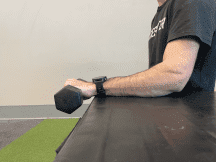
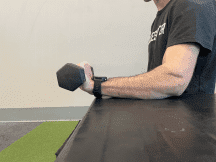
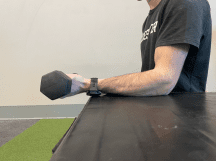
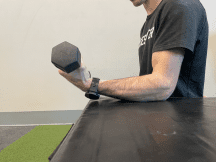
4. Wrist: Weighted Flexion and Extension
With your elbow slightly bent supported on a table, hold a five pound dumbbell in your hand. Only your wrist and hand should be hanging off the table. With your palm facing down, pull your wrist up towards you and then slowly lower the weight (top photos). Then, turn your hand so that your palm is facing up and bring the dumbbell up toward you, then slowly lower (bottom photos). Perform two sets of five in each direction per hand.
5. Upper back/thoracic mobility:
Thread the needle. On all fours, bring one arm up to expand your chest as much as you can, then bring it under your chest and to the opposite side of your body, getting as much rotation through your upper back as you can. Hold for 30 seconds, and repeat two to three times per side.
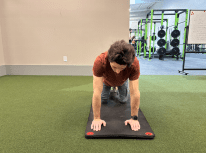
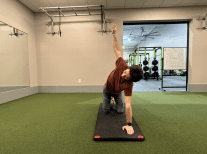
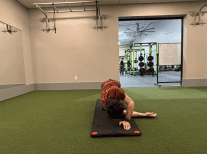
In addition to performing this warmup, there are a couple of things that you can do during the forerunning process to stay in tune with your body and decrease your chance of getting injured. Tracking volume and intensity of both work days and personal climbing sessions can be very helpful. You could do this by keeping a journal or an Excel sheet that you write in at the end of a session. If you notice that you have had multiple intense days of climbing in a row, then it is probably a good time to deload.
Examples of deloading include:
- Not setting a skeleton so that you can warm up slower before assisting your teammates in the forerunning process
- A day of wall maintenance with little to no setting or forerunning at all
- Putting more intention into not setting that movement some days or avoiding climbing others’ boulders or routes that include that movement. This is especially helpful if you have found a more specific movement that is causing you pain or discomfort.
Because you are part of a team, it is important to have a conversation with your coworkers about how you can rest without negatively impacting the team’s productivity. Remember, while doing less work to take care of your body may make it feel like the team is losing valuable time, deloading can actually help to keep all members of a team healthier and lead to less time taken off of work due to injury or illness.
It is also important to scan how you are feeling at different times during the work day, such as before and at various points during forerunning. Check to see if you are losing power, peeling off of holds more frequently, or if any recent or nagging pains are returning. This can give you information on if it is time to back away from a certain wall angle or hold type.
Some examples of scanning and adjusting include:
- If you are recovering from a finger injury and your finger pain is starting to increase toward the end of the day, you can ask a coworker to take over on the climb that has been aggravating it.
- If you have done the same heel hook 10 times and your leg is starting to get really sore, don’t do the heel hook anymore. If the move still hasn’t been done, ask another coworker to work on it.
- If the move has been done, add a different foot to allow you to skip that move for the remainder of the forerunning session.
Understanding what is hurting your body can help you remain a valuable member of your team each day while preventing you from developing or worsening an injury.
Taking a quick break to rest, eat, or drink (or all three!) could be helpful as well, and you can still use that time to be productive by planning any changes you want to make to your climbs or by helping your coworkers come up with ideas for theirs.
Finally, there are a couple of exercises that you can do outside of work to help improve posture and decrease pain. The first is a foam roller stretch for the muscles on the front of your chest. These muscles are utilized very frequently in climbing and can cause poor posture if they get too tight.
Lie vertically on a foam roller so that your head is in contact with one end and your tailbone with the other. Keeping your back flat on the foam roller, bring your arms out to the side at about a 90 degree angle to your body (photo 1). If your back arches here, decrease the angle of your arms. Breathe through the position for about 20 seconds, then see if you can increase the angle of your arms (photo 2). Repeat through five to six positions, or for about three minutes.
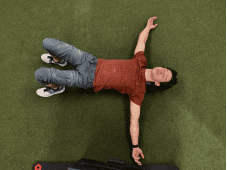

After this, spend at least five to ten minutes gently stretching any muscles or body parts that you used a lot that day–or anything that you know is more prone to injury on your body. This can help keep you healthy and decrease the amount of soreness you feel the next day.
Finally, remember that you can modify these exercises to find a program that best works for you. I emphasized the five parts of the body most commonly injured in routesetters, but you know your body best. If you have a nagging injury or a body part that is most prone to get hurt, feel free to add a stretch or strengthening exercise for that into your routine. Additionally, if any of these exercises hurt, do not do them. Try to find a way to modify it, or eliminate it completely if needed. There should be a variation of this program that works for most people.
Visit a Physical Therapist
If you have questions about any of this information or want to better understand how this applies to you specifically, visit a local physical therapist to learn more.
Routesetters play such a crucial role in keeping the climbing community alive and thriving. We appreciate all that you do and are grateful to have the opportunity to give you knowledge to make your lives healthier and to help to enjoy your jobs and keep route setting for as long as you’d like.
Author Bio
Emma Benson is a second year physical therapy student at Virginia Commonwealth University in Richmond, VA. She has been climbing since she was 10 years old and it is a very important part of her life. She also has a passion for coaching climbers, which she has done throughout her undergraduate and graduate career and would like to continue doing as long as possible. After graduation, Emma would love to work primarily with climbers in a climbing gym setting.
When she isn’t climbing, you can find her running, cozying up with a good book, or playing fetch with her dog, Bonnie!
If you have any questions or comments about this article, you can reach Emma at ebenson321@gmail.com
More Information
Check out Dr. Evelyne Lajoie’s Blog Post:
Lajoie, E (2020, October 4) Route Setting Injuries Survey: Descriptive Results. The Climber’s Clinic Blog https://lacliniquedesgrimpeurs.blogspot.com/2020/10/route-setting-injuries-survey.html
- Disclaimer – The content here is designed for information & education purposes only and the content is not intended for medical advice.
Related Posts