Elite Climbers: Your Iceberg Profile and Why It Matters
Climbing, to no one’s surprise, is hard. However, more people are drawn to sport climbing and bouldering than ever before. Climbing itself is not new to the realm of sports; in fact its origins date back to a necessity for survival among the people living in the Alps. Its recreational history isn’t relatively modern either; climbing was reported as early as the 19th century in both Asia and Europe. All this to report however, this paper investigates cognitive commonalities shared by climbing athletes. It will aim to answer questions like “What aspects of mentality contribute to climbing success?” and “If someone does not have a former athletic background, what are the keys to success they might hope to obtain to become a “good” climber?” The goal of this article is to examine the psychology of those drawn to sport climbing and investigate whether some people are better primed for the sport than others by diving into and explaining their iceberg profiles. In addition, we will also mention some of the physical attributes of elite climbers and why these attributes are imperative to earning success.
There is already ample research that describes the physical qualities of climbers that contribute to success. Some of these qualities include the following written by Saul et. al., “Hand, forearm strength and endurance are highly important elements in elite climbers. An efficient climbing style with perpetual focus and accuracy, high speed and low exhaustion due to adaptation to repeated isometric exercise is helpful in the ascent, while low body fat and a large bone-to-tip pulp make it easier. Constant training is essential, e.g. eccentric-concentric training of finger flexors, which should be followed by active recovery” (97). In other words, forearm and finger strength are crucial elements to climbing more advanced routes. Aerobic endurance is also notably important: long routes, such as those found among traditional (“trad”), sport, and top-roping styles of climbing, require endurance in order to piece together moves with minimal rest to avoid a fall. When an athlete has poor endurance, they experience “pumps” or areas of lactic acid buildup that settle, typically, in the forearms. Greater endurance means that a climber can advance further along the route with less lactic acid formation, reducing the need for rests and increasing efficiency of the climb.
On the other hand, a climber can have both excellent strength and muscular endurance and still fail to develop. A missing factor, then, must be something intangible. Highly familiar to the general public is the notion of the “Growth Mindset”, which is described in the Harvard Business Review as, “…Individuals who believe their talents can be developed (through hard work, good strategies, and input from others) have a growth mindset. They tend to achieve more than those with a more fixed mindset (those who believe their talents are innate gifts). This is because they worry less about looking smart and put more energy into learning” (Dweck 2016). Athletes who see setbacks, such as trouble landing a move on a problem or breaking into a new grade, as opportunities for learning, reflection, and self-development will achieve better long term results than their “fixed mindset” counterparts. This is an important consideration for elite climbers because training often involves “projecting” a climb, which consists of breaking down a climbing route into segments and climbing those segments until they are completed consistently with efficiency. Efficiency is key for energy conservation. Often, these projecting sessions involve lots of failure (falls) and require the climber to rethink their approach by problem solving. Needless to say, athletes who utilize a growth mindset will be spurred by their errors to try something new, and also apply the lessons gained from their failures to future climbs to elicit faster success. Athletes with fixed mindsets will fail climbs and determine that they are simply unable to do the route, and move on without ever learning how to adjust their failures for success. Of course, an important factor to consider is the level of proficiency of a climber. For example, it is unreasonable to expect oneself to complete a boulder of great difficulty, such as a V9 on the Vermin Scale, as an intermediate climber used to projecting V4 and V5. Technique and strength required for elite climbing takes both time and adequate training.
How, then, does the Growth Mindset relate to the Iceberg Profile? The Iceberg Profile, illustrated by William Morgan in the 1970s. He assessed the idea of overtraining in athletes and ultimately concluded that athletes with high success rates displayed low rates of negative mood states: stress, depression, anger, fatigue, and panic, and displayed a positive mood state which he coined vigor, or energy. In summary, the line graphic of these findings displayed what looked like an iceberg for each athlete, and indicates that athletes who are able to balance their emotions and overall think more positively about their sport.
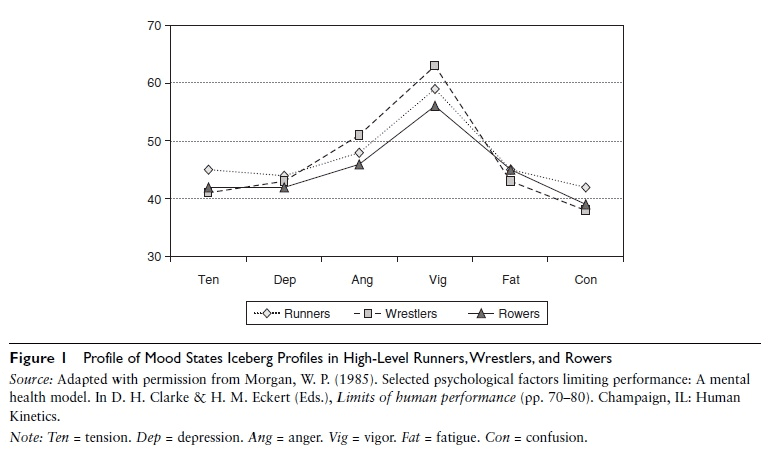
Figure 1: Profile of Mood States Iceberg Profiles in High-Level Runners, Wrestlers, and Rowers. ( Copied from https://psychology.iresearchnet.com/sports-psychology/sports-and-personality/iceberg-profile/#google_vignette)
In Figure 1 above, runners, wrestlers, and rowers were surveyed to identify the level at which each athlete felt these six emotions. The athletes with the best success in their independent realms were measured having the highest amounts of vigor and relatively low amounts of tension, depression, anger, fatigue, and confusion. Recent studies suggest that successful climbers, too, fit the iceberg profile above. Saul et. al.’s research determined that a successful climber also typically exhibited the “iceberg profile”, meaning that climbers with high amounts of energy and low amounts of the other five “negative” emotions were often more successful than their counterparts with inverse iceberg profiles (inverse meaning low amounts of energy and high amounts of the other 5 negative qualities). Additionally, their paper reports that climbers were often, “…Introverted and motivated to achieve success” (96). This profile is evident when it is considered how often a climber must make risky decisions, like making a dynamic movement or relying on a small foot chip. In other words, a good climber must understand how to control elements like fear and anxiety in order to focus on the demands of the route. If these emotions dominate the athlete, ascension of skills in the sport is difficult.
Every climber experiences bouts of anxiety about a route, so how do elite climbers tame their anxiety? A systematic review regarding the psychology of rock climbing written by Mangan et. al. suggests that, “…They found higher experience was associated with lower perception of risk”(11). Meaning, the greatest preparation climbing athletes can do to limit the way that anxiety affects their performance is gain experience. This sounds like a no-brainer, however this does not imply that a climber must climb outdoor routes, in fact most training for elite climbers is done in the indoor gym with plastic holds. Here, the athlete can hone their techniques and try dynamic, anxiety-inducing movements in an environment that is heavily padded, low to the floor, and safe from other elements like rocks, trees, and weather. This process works to encourage the athlete to trust their skills and fear less about the risks associated with failure. Many world-class climbers, notably Adam Ondra and William Bosey for example, create an indoor route that models a project they are working on outdoors, so in cases where the weather is not ideal for climbing or the climber doesn’t live in the same area as the route, they can still practice moves and remain “fresh” for their next send on it.
Mangan et. al’s research additionally reports that the sport’s benevolent, supportive community draws athletes together to help one another. Often climbers climb in groups, where they collectively help preview each other’s routes, belay or spot as needed, and offer words of encouragement. Often you can go to a bouldering spot alone, for instance, and walk up to a climb crowded with a collection of crash pads from climbers working on the rock. It is common to ask for “beta”, or the sequence of moves, on a climb you’re stumped on, from a complete stranger who will happily share their progress. Climbing’s niche but amiable nature is likely due to the personality traits of those drawn to climbing; people whom Mangan et.al. describes as having, “…high openness, agreeableness, grit, sensation seeking and low trait anxiety” (10).
While personality doesn’t single-handedly dictate the amount of success a climber has, there is evidence to support that athletes with iceberg profiles tend to succeed more often than those whose icebergs are inversely skewed. Legitimate grip and hand strength is a significant factor, as is high endurance and the ability to access climbs and gyms to facilitate training. However, the ability of a climber to remain calm, collected, focused, and motivated on their route and projects should be studied in the future to determine long term potential for success in rock climbing. Strength and endurance can be gained through sport-specific training, but personality and the way we perceive challenges is difficult to alter. While, understandably, we cannot force ourselves to fit a profile we are not, it might be helpful to our sport (and maybe in general) to be mindful of challenges that flare our anger or sadness, and change our internal dialogue from something that asserts, “This is too hard, I need to give up” to something that instead says, “This is hard right now, but I’m going to give it another try”.
Author Bio
Shauna Nuss is a doctor of physical therapy student at Stony Brook University. She is a member of the Student Climbing Special Interest Group. A free group for physical therapy students who are interest in rock climbing injuries.
Works Cited
- Dweck, Carol. “What Having a “Growth Mindset” Actually Means.” Harvard Business Review, 13 Jan. 2016, hbr.org/2016/01/what-having-a-growth-mindset-actually-means.
- Mangan, Kevin, et al. “The Psychology of Rock Climbing: A Systematic Review.” Psychology of Sport and Exercise, vol. 76, no. 76, 1 Oct. 2024, pp. 102763–102763, www.sciencedirect.com/science/article/pii/S1469029224001742#cebib0010, https://doi.org/10.1016/j.psychsport.2024.102763.
- Saul, Dominik, et al. “Determinants for Success in Climbing: A Systematic Review.” Journal of Exercise Science & Fitness, vol. 17, no. 3, Sept. 2019, pp. 91–100, https://doi.org/10.1016/j.jesf.2019.04.002.
- Disclaimer – The content here is designed for information & education purposes only and the content is not intended for medical advice.
Related Posts