Overcoming Fear and Pain in Climbing: A Journey to Rebuilding Confidence
“Nah, that climb is just not my style.”
“I’m just not as strong on those types of holds.”
“That move is a little sketchy for me.”
“I’m never going to be able to climb like I used to.”
Sound familiar? Perhaps a sloper led to a nasty wrist injury, or a heel hook led to a definitive “pop” in the knee, all of which took months to heal, and still, the pain seems to linger when put in the scenario that caused the initial injury. Even once an injury seems to have healed and we finally are back to our usual training schedule, there remains that nagging pain and fear of re-injury with the obvious solution: avoid the things that you associate with causing that injury. But what if I said that the best way to overcome your pain is to do the exact opposite – to put yourself in that position over and over and over again?
It’s a natural reaction to avoid what hurts us, to steer clear of holds, moves, or situations that remind us of an injury or are painful. After all, pain serves as an important protective function to our bodies and is often treated by withdrawal from the stimulus. Fear is an emotional reaction to a specific, identifiable, and immediate threat, and over time, we learn to fear a movement based on the past knowledge that it hurt us. Our minds can link certain moves or positions with danger, even when our bodies are physically healed. This could explain why, for example, a drop knee might provoke pain even though the injury occurred a year ago and has healed fully. This protective response is beneficial in the short term; however, it can cause more problems in the long term as past injuries can leave a mental imprint where the brain interprets specific scenarios as threats, triggering discomfort, pain, or hesitation when the actual risk is minimal.
The Science of Pain and Central Sensitization
Let me preface this by saying, “No, it’s not in your head.” Pain is an output of our nervous system that is initiated via activation of specialized nerve endings that detect harmful stimuli (inflammation, cuts, etc). Typically, once an injury heals, the activation of those nerves stops and, subsequently, the pain does too. However, that is often not the case in people who have persistent pain. This unfortunate neuroplastic phenomenon is termed central sensitization – meaning the nervous system has adapted to remain sensitized to stimuli, even though it shouldn’t be.
This adaption often results in:
- prolonged pain (i.e., pain longer than 3-6 months)
- pain that is more severe with the same stimuli (e.g., something that was normally a 3/10 on a pain scale is now a 6/10)
- pain with stimuli that are normally not painful (e.g., something you’ve done many times before is suddenly painful).
Naturally, this is an extremely frustrating experience for climbers and may also cause fear, apprehension, or anxiety toward climbing. This is an entirely normal maladaptation because it is our body’s way of helping to limit the use of a potentially injured area and facilitate healing. This results in our body learning to overreact, where it takes a lot less to cause this stimulus. And then once the slightest movement in the right direction sets off that signal – poof – pain, so we avoid the movement altogether.
This process can be visualized in the following graph:
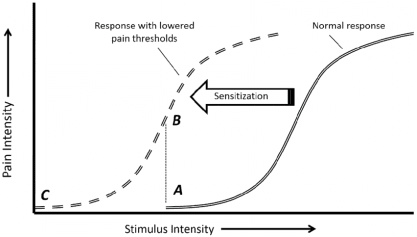
The graph illustrates how central sensitization shifts the pain response. In a normal system, higher stimulus intensity is required before pain is perceived. However, when the nervous system becomes sensitized, pain thresholds lower, meaning even mild stimuli can elicit significant pain. This explains why movements that were once tolerable or non-painful may suddenly become triggers, reinforcing fear and avoidance behaviors.
Calculated Exposure: The Key to Overcoming Pain
Research shows that our nervous system is wired to learn from experience, and the key to overcoming pain and apprehension isn’t avoidance—it’s calculated exposure. Pain isn’t just a physical sensation, it’s a complex interaction between the brain and body. Techniques like expectancy violation/inhibitory learning—methods used to challenge and change fearful expectations – and graded exposure – a step-by-step process of gradually facing painful movements or sensations – can be powerful tools in physical therapy. These approaches can help us retrain our nervous system and rebuild trust in our bodies.
Graded Exposure
Briefly, graded exposure is a step-by-step approach where we gradually reintroduce feared movements or situations that cause pain in a sequential format. For example, a climber experiences hesitancy in increasing their load in a crimp position after recovering from a healed pulley injury a couple of years ago. Although this climber received professional rehab and the injury has healed properly, the climber experiences pain and apprehension when pulling from a small edge. Here, we see that the climber associates load with danger and that the application of load will cause injury to their pulley, which they perceive as more fragile.
To desensitize the nervous system, decrease pain, and instill confidence, we can gradually increase the intensity of the pull, starting with the least anxiety-provoking scenario. By using larger holds in a crimp position and progressing by increasing the load and duration while decreasing the crimp size, we are retraining the body to tolerate load without activating our pain system. Moreover, we are building tolerance to fear and increasing our exposure to the stimulus with the hope that increased exposure decreases danger perception.
Expectancy Violation
Expectancy Violation is a strategy that spurs from an inhibitory learning model. This model suggests that fear reduction occurs by creating new associations that compete with the original pain-provoking situation. Instead of erasing the fear memory, we are retraining the brain to no longer predict that a certain movement will produce a negative outcome. To enhance this model, we can use expectancy violation, which exposes an individual to a situation that violates their expectations about a feared event. Unlike graded exposure therapy, which follows a hierarchical model built on the concept of decreasing pain, expectancy violation doesn’t require pain to be present and can be applied to any feared event. The approach is to directly expose a person to their fearful expectation to prove them wrong and disrupt the belief that the feared event will happen. The technique would focus on breaking the fear cycle by creating a mismatch between what a person expects to happen and what actually happens.
Picture this: a climber ruptured their achilles tendon after doing an explosive step-up dyno, which required surgery and physical therapy (PT) to follow. While PT helped to regain mobility and strength, especially to target motions in climbing, the climber felt fearful of any dynamic movements even after many months past PT discharge. They now expect that with every dynamic movement that involves a dynamic ‘step-up,’ their achilles will rupture/be painful. We can refer to this as adopting a “wear and tear” mindset. Applying this concept would be choosing scenarios that maximally challenge the climber’s expectations. Ideally, multiple attempts or repetitions of the chosen activity should be completed in one session. For this example, scenarios would similarly load the achilles to how they injured it, essentially “testing” what they think will happen. At first, this could look like completing a box-step up and then progressing to on-the-wall movement with less support under more challenging circumstances to keep the fear elevated. As the climber progresses and realizes that these movements do not cause harm, they will begin to reframe their expectation that “this motion will cause harm” and provide a more positive experience.
This process of fear acquisition and extinction can be visualized as follows:
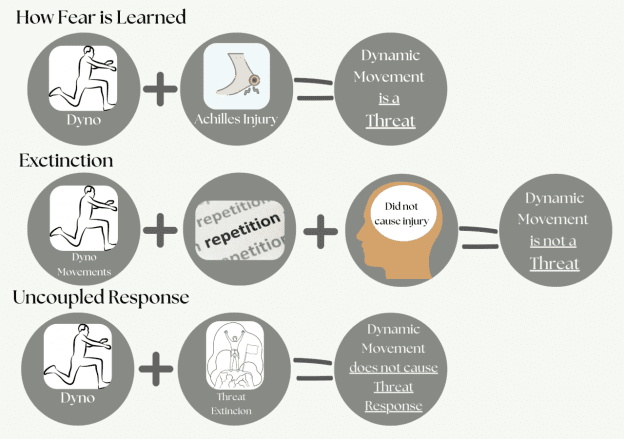
As shown, fear is learned when an injury (e.g., an Achilles rupture) becomes associated with a specific movement (such as a dyno). Over time, avoidance reinforces the belief that dynamic movement is dangerous. However, through repeated exposure that violates these expectations—where the feared movement occurs without pain or injury—the brain begins to reframe its prediction, reducing the threat response.
Getting Started
The first step in overcoming fear and pain is to consult a professional (preferably a movement specialist or a Physical Therapist) about how your injury has caused limitations in the way you want to move. Mention that you are fearful of a movement and how it might elicit a certain painful stimulus. Together, you can come up with a progressive plan that is tailored to your feared situation and focuses on two main goals;
- Retrain the movement physically
- Re-training your nervous system’s response to the movement.
Tips for Facing Your Fears
When going through your scenarios or exercises in and outside of the clinic, mental engagement is just as important as physical. It can be easy for our minds to wander, so here are some things to think about to stay on track and keep focused.
- Be PresentStay focused on the task at hand. Cognitive awareness has a larger impact on overcoming fearful expectations. Avoid letting your mind wander to your “happy place”—you can’t truly feel progress if your mind is climbing El Cap!
- Write It Down!Track your progress mentally and physically. Just like you track climbing grades or training progress, take a second to jot down some notes about how you felt after each repetition. Reflecting on your emotions and sensations can highlight your improvements and help you stay motivated. I’ve provided a downloadable template to help you organize.Exposure Therapy Reflection Journal
- It’s All YouDon’t become attached to things that make doing the movement more comfortable. Remove those training wheels. While working with a PT is valuable, your success ultimately comes from your own efforts. Your success is attributed to your actions and the resilience you’ve built.
Overcoming fear after an injury is a journey that requires patience, courage, and a willingness to challenge the limits of both body and mind. While the protective instinct is to avoid pain, leaning into the discomfort through strategies like graded exposure and expectancy violation are more beneficial ways to reorganize the brain’s hypersensitive responses. These approaches empower climbers to reclaim their movement, rebuild trust in their bodies, and restore their past climbing strength. So, the next time fear creeps in, remember that progress lies in confronting it, one calculated step at a time. With the right mindset, support, and approach, you can look at a sloper with a new perspective, and maybe the holds and movements that once seemed out of reach have become your strongest allies yet.
The Research
- Leeuw M, Goossens ME, Linton SJ, Crombez G, Boersma K, Vlaeyen JW. The fear-avoidance model of musculoskeletal pain: current state of scientific evidence. J Behav Med. 2007;30(1):77-94. doi:10.1007/s10865-006-9085-0
- Vlaeyen, J. W. S., & Linton, S. J. (2012). Fear-avoidance model of chronic musculoskeletal pain: 12 years on. Pain, 153(6), 1144–1147. https://doi.org/10.1016/j.pain.2011.12.009:contentReference[oaicite:1]{index=1
- Osterweis M, Kleinman A, Mechanic D. The Anatomy and Physiology of Pain. Nih.gov. Published 1987. https://www.ncbi.nlm.nih.gov/books/NBK219252/
- Craske MG, Treanor M, Conway CC, Zbozinek T, Vervliet B. Maximizing exposure therapy: An inhibitory learning approach. Behaviour Research and Therapy. 2014;58(1):10-23. doi:https://doi.org/10.1016/j.brat.2014.04.006
- Nils Oudhuis. Just Load It! – Trust me, I’m a Physiotherapist. Trustmephysiotherapy.com. Published October 6, 2016. Accessed January 18, 2025. https://trustmephysiotherapy.com/just-load-it/
- Latremoliere A, Woolf CJ. Hypothesized sensitization process. In: Central Sensitization: A Generator of Pain Hypersensitivity by Central Neural Plasticity. The Journal of Pain. 2009;10(9):895–926. Figure 1. Available from: https://www.researchgate.net/figure/Hypothesized-sensitization-process-The-normal-response-curve-double-line-portrays-the_fig1_281139768
Author Bio

My name is Riley Hess, and I am a 2nd year Doctor of Physical Therapy student at Massachusetts College of Pharmacy and Health Sciences (MCPHS). I’ve been climbing for around 6 years and fell head over heels for the sport and its community. I wouldn’t be on my current path without it…and its fair share of injuries. With pain science emerging as an exciting area of research, my goal is to shed light on chronic injury recovery and provide hope to those navigating their own path toward healing.
Instagram: riley.dh
Email: rileydhess@gmail.com
- Disclaimer – The content here is designed for information & education purposes only and the content is not intended for medical advice.
Related Posts