BFR for Climbers with Shoulder Pain
You are on the last move of your proj of 2 years and in the perfect drop knee, reaching overhead to a gnarly crimp that’s going to send you to a godsent jug to top out…but as you hit the crimp your other hand slips. Most of the weight now on your one arm, crimping for your life, you pull from your arm and push from your legs with everything you have to reach the jug … and … Psssaattt! You stick the jug, get a high heel and top out your long time project! Sick! But now that you’re on top, you feel a tweak in your shoulder. It must have happened when your hand slipped and most of your weight was sent into the other arm. You realize you should probably take it easy and not push it too much more trying anything else that day.
A few days go by, your shoulder does not seem ready to start climbing again. What should you do? Blood flow restriction (BFR) training has become a proven way to improve strength and conditioning effectively while rehabilitating an injured joint without stressing that joint too much. Research is finding it may prevent a loss of motor patterns, A.K.A. technique, in addition to strength and recovery during rehab.
What is BFR?
BFR is a technique that allows you to train at lower intensities with higher reps while still making similar strength gains, compared to regular high load strength training. Research is still being developed, especially in the athletic population, but there is a lot of research already out there with some of it performed on athletes.
BFR was originally established in the late 1960’s in Japan and originally called KAATSU. It was predominantly performed in Japan up until around 2008. Since then more BFR units have become available and more research has been performed and resulted with ongoing promising results.
BFR is performed either with a stiff or elastic strap that goes around the part of the limb closest to the trunk. An electronic or handheld pump then attaches to the straps to pump them to a set pressure to create venous occlusion, or in other words block blood from leaving a specific limb. Some people will use a strap without measuring the pressure or a very thin strap. Both of these are inadvisable as it adds risk of it being too tight, potentially leading to tissue damage, or too loose, not providing sufficient pressure for benefit. BFR works by allowing blood into the limb through the arteries while restricting blood flow out from the veins. This promotes physiologic responses, which have been known to promote muscle hypertrophy (increased muscle size) and increased muscle recruitment (amount of engaged muscle fibers). The research has found that strength gains do not only happen in the part of the limb distal to the strap (down your arm), but proximal (up your arm) too and there may also be cardiovascular benefits.
In your case, the BFR strap would be placed just below the shoulder and above the bicep muscle belly to promote strengthening in that arm. It would promote strength not only below the strap, but also above.
Is BFR comfortable? No. But would you call any strength training or conditioning program ‘comfortable’? When performing exercises with BFR, you will likely feel an intense pump. It may feel like pressure in your arm, a strong squeeze, muscle burn, and/or a heavy feeling. You should not feel severe pain or discomfort. Tingling that ceases after BFR and delayed onset muscle soreness (DOMS) may present too, but is not worrisome. The tingling is likely from nerve conduction blockage (a temporary interruption in the signals that nerves send, similar to when you’re sitting in an awkward position for a long time, and your leg “falls asleep”). The DOMS are a normal response when performing exercise for hypertrophy. If tingling persists or you feel any symptom other than what was described here, seek a physical therapist for a proper assessment and ways to safely progress back to rock climbing.
Key point: While the theoretical case presented at the beginning of this article is of an acute injury (short term; typically within 2 weeks of initial injury), there is some research proving benefit for more chronic (long term; typically over 3 months) injuries. Weakness due to an injury can be addressed with BFR training, however if you are unsure about it, consult a physical therapist first.
Assessment
The first thing you should do with your injured shoulder is assess whether or not you have a fracture in your shoulder and rule out any contraindications. X-rays are the best way and gold standard to assess a fracture. However there is a test you can perform to assess at home. First, if you have unrelenting pain that increases with movement, you should go for an X-ray. If you do not have unrelenting pain, you can perform the bony apprehension test as shown below in video 1 to attempt to rule out a fracture. A positive test is apprehension of the movement. If you are positive, see a doctor.
Video 1: Modified Apprehension Sign
Bony Apprehension Test:
You will need a partner for this test. Your partner will grasp your wrist with one arm and hold the elbow still with the other. Your partner will then slowly lift the upper arm 45 degrees away from the body and then rotate the arm 45 degrees away from the body.
*If you or your partner do not feel comfortable performing this test, or you do not have a partner, that is okay, it is not an absolutely necessary step. But again, if you are concerned about a fracture, see a doctor before proceeding with exercise.*
After a fracture has been ruled out or you are ready to move on, you can start to assess what’s going on with your shoulder. A study from 2016 found that 17% of all climbing injuries consist of shoulder injuries. The most common ones being superior labral anterior to posterior tears (SLAP tear), shoulder impingement, anterior inferior labral tear following anterior dislocation, biceps tendon tear or rupture in the shoulder, and supraspinatus tendinopathy. All of these can initially be treated with conservative treatment. The following are some symptoms you may be experiencing from your shoulder injury and can likely be treated effectively with BFR strength training:
- Clicking, catching, popping, or locking
- Weakness with or without pain
- Pain in the front of the shoulder
- Pain with repeated overhead reaching
- Painful arc (pain only in the middle of the motion, somewhere from 60-120 degrees, when bringing your arm from your side to overhead like making a snow angel)
- Looseness
- Slipping
- Giving out
Fun fact blurb: A study performed in 2022 looking at climbers without any pain found that 80 out of 100 of their elite climber participants had an MRI diagnosed shoulder pathology (typical presentation of injury). These pathologies ranged from tendinosis of varying muscles, to labral tears, and to articular cartilage changes within the shoulder joint. Put simply, the imaging was positive for changes that would be considered abnormal. These climbers were all asymptomatic though. The importance here is to recognize that many people may think that they need surgery if an image is abnormal when in reality they don’t. So in your case, if you were to get imaging and find something abnormal in your shoulder, but rehab alone eliminated your pain and allowed you to return to climbing, you likely do not need surgery. *remember this is still best discussed in person with a professional in front of you*
If your pain is severe and debilitating, the best action to take would be to see a professional so they can accurately diagnose the pain to provide accurate treatment. If your symptoms are mild or moderate, you will likely be able to treat them effectively on your own. Keep in mind that if your symptoms do not seem to be improving after a few weeks, even if they are mild, you should see a professional.
As of now, the main contraindications to consider before performing BFR are if you have a history of thrombosis (blood clots) or cardiovascular disease. If you have either of these, consult a medical professional before starting BFR training. Other yellow flags to be aware of are hypertension, Diabetes Mellitus, respiratory disease, obesity, a history of smoking, and/or if you are above 65 years old. Yellow flags do not mean you should not perform BFR, but if you do, perform it with lower levels of pressure and cease the exercise if you notice any abnormal symptoms.
The goal of rehabilitating the shoulder joint is to get it moving and strong without producing pain so you can get back to pain-free climbing. If you have shoulder pain and continue to participate in climbing without the proper rehab program, you are likely to make compensations with your movement to reduce pain to allow yourself to perform. This promotes inefficient movement. This way your injury will likely not recover well and you will learn new compensated movements resulting in lower quality climbing.
A typical rehabilitation program would likely start by calming the joint down if it is a recent injury followed by finding pain free ranges of motion and pain free weight intensities for strength training to promote healing without promoting a change in movement. This way, the climber will be able to promote healing in preparation for return to the wall and prior level of climbing.
To start, assess your shoulder motion using functional combined movements. Move your unaffected arm first, then move your injured side to compare and see if there is a difference and what that difference is (range of motion or pain):
- Reach to your other shoulder across your chest
- Reach behind your back
- Reach behind your head
Range of Motion Assessment
Then you will want to assess your strength. The following are 4 of the most utilized shoulder movements when climbing. Test your unaffected arm first, then your injured side to compare and see if there is a difference and what that difference is (weakness or pain). Start with body weight, the same as looking at motion as above, then add weight slowly to assess. Wherever pain presents, don’t increase weight from there:
Video 3: Flexion
Video 4: Abduction
Video 5
Video 5: IR at 90 deg (if painful to lift your arm up, perform this with your elbow at your side)
Video 6: ER at 90 deg (if painful to lift your arm up, perform this with your elbow at your side)
If there are any differences or pain present, take note of these as you can come back to reassess them and don’t increase weight if pain presents.
Device Selection
When choosing your BFR device is it important to consider the material, strap thickness, and how pressure is measured. As mentioned earlier, there are stiff and elastic straps to choose from. Generally stiff straps, made from nylon, are easier to measure as they maintain the pressure during exercise, while elastic straps will create pressure when initially applying them and then add more pressure when inflated. Elastic straps may be harder to maintain pressure during exercise. Strap widths are generally 10-12 cm with some wider and some more narrow. The wider ones allow for increased restriction without too much pressure in one point. Some straps have an electronic pump that can measure the pressure for you, while others will have a manual pump where you have to measure the pressure yourself.
The following are a couple good quality BFR cuffs that you may find as a good choice for you:
- https://saga.fitness/products/the-bfr-cuffs (These are the cuffs used in the videos below)
- https://bstrong.training/products/b-strong-training-system
More options can be found on Amazon or just by searching Google.
Protocol
Limb occlusion pressure (LOP) or arterial occlusion pressure (AOP) is the pressure required to fully restrict blood flow into the limb through the arteries and measured in mmHg. If using a manual pump to find this, you will need to use a Doppler ultrasound or if you have a BP cuff you can use 1.2 or 1.5 times your systolic blood pressure (the top number) to find 100% LOP. Exercise is then performed at a percentage of your LOP, typically between 40-80% with most research studies finding diminishing returns past 50% LOP for the arms. If you do not have an electronic pump or Doppler ultrasound and still want to perform BFR, you can use the perceived wrap tightness scale to estimate an accurate pressure. This is a scale out of 10 where 0/10 refers to the arm being free with no strap and 10/10 is extreme pressure with no pain. Aim for 7/10 tightness; moderate pressure with no pain. Remember this is an estimation and will not be as accurate compared to measuring the pressure. I will add that there have been some recent studies questioning the reliability of the perceived wrap tightness scale and with many people underestimating the pressure and some overestimating. My advice if you choose to use this method is err on the side of caution and keep the strap looser rather than tighter.
Once you find the right pressure you can start performing your exercises! A general protocol of using 20-30% your 1 rep max (1RM) for 4 sets, 30/15/15/15, with 30 second rests between sets and 2 minutes between exercises has been found to produce muscle hypertrophy. If you do not know your 1RM you can find it using a 1RM calculator.
It’s ok to reach failure on your last set of 15 and if you are able to perform the last set of 15 fully for each exercise session in a week, you may increase the weight by 1-2 lbs for an appropriate resistance. BFR can be performed 2-4 times per week with each session not lasting more than 20 minutes. Performing BFR everyday for 1-2 sessions per day has been found to be okay as long as you do not exceed 3 weeks.
The Rock Rehab Pyramid
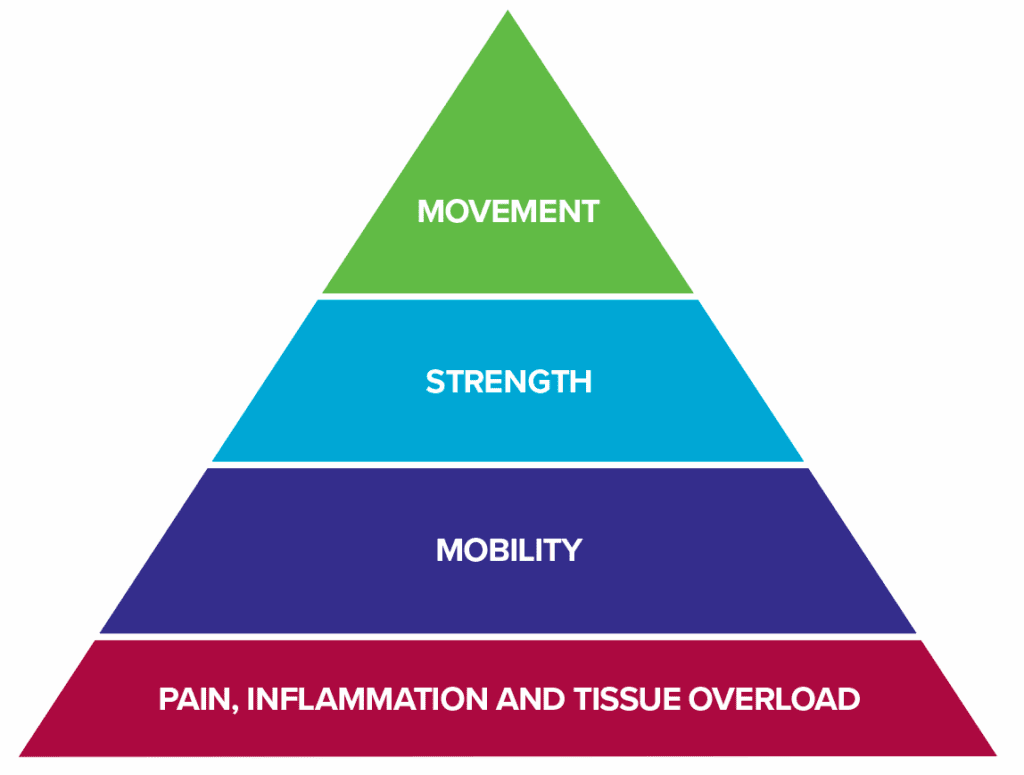
Dr. Jared Vagy, doctor of physical therapy, developed the Rock Rehab Pyramid as a structured way to safely rehabilitate climbers. It was initially introduced in his book Climb Injury-Free. The goal of the four-phase process is to take you from the pain, inflammation and tissue overload stage to gain full mobility, strength and eventually pain-free climbing movement.
After an initial acute injury, you will be in the pain, inflammation, and tissue overload level of the pyramid AKA the ‘unload’ level where the goal is to promote proper healing and recovery to reduce pain and inflammation while minimizing loss of muscle mass. This will take you to the mobility stage where the goal is to achieve pain free range of motion. Then the strength level will focus on increasing your strength back to performance level to prepare you for the movement level where you will retrain your coordination on the wall at a safe intensity. Depending on the stage of your injury and current symptoms, you may start at different levels. For example, if you already have pain free range of motion, you may start at the strength level. To move up a level you need to have a decrease in pain and soreness. If pain and soreness increase, regress one level. If you have no change in pain and soreness, stay at the same level for now.
Unload exercises:
Just walk with normal arm swing if non-painful or reduced arm swing if normal is painful.
- 1-2 times a day for up to 3 weeks
- Occlusion pressure: 40-80%
- Start low and gradually increase
- 5-20 minutes
- Start at 5 minutes and gradually increase to 20 minutes
- Remember the goal at this level is to provide healthy healing without losing any muscle. In essence, you are trying to ‘calm’ the shoulder down to prepare it for rehab.
Mobility exercises:
Focus here is to improve your pain free range of motion to prepare you for strength training. These exercises will all be performed with only bodyweight and with the BFR cuff on. If pain presents, first try reducing your range of motion before regressing to the unload phase.
- Parameters
- Occlusion pressure: 25-50%
- Start low and gradually increase
- Reps: 30/15/15/15
- Rest 30 seconds between sets
- Rest 2 minutes between exercises
- If the BFR is too uncomfortable, you can release the pressure between exercises
- Total workout time with the BFR on should not exceed 20 minutes.
- Occlusion pressure: 25-50%
- Bent over rows
- Shoulder scaption
- Shoulder external rotation
- Prone shoulder horizontal abduction
Video 7: Bent over rows
Video 8: Shoulder scaption
Video 9: Shoulder external rotation
Video 10: Prone shoulder horizontal abduction
Strength exercises:
Focus here is to improve your strength to prepare you for movement training. These exercises will all be performed using light weight with the BFR on to prepare you for movement training.
- Parameters
- Intensity: 20-30% 1RM. Find your 1RM with the 1RM calculator. I’d recommend doing a 10 rep max test to calculate your 1RM. So find the weight you can perform only 10 reps with and enter it into the calculator.
- After a full week of the strength level, if you are able to complete all 4 sets of a specific exercise fully, you may increase the weight 1-2 lbs for adequate intensity.
- Occlusion pressure: 25-50%
- Start low and gradually increase
- Reps: 30/15/15/15
- Rest 30 seconds between sets
- Rest 2 minutes between exercises
- If the BFR is too uncomfortable, you can release the pressure between exercises
- Total workout time with the BFR on should not exceed 20 minutes.
- Intensity: 20-30% 1RM. Find your 1RM with the 1RM calculator. I’d recommend doing a 10 rep max test to calculate your 1RM. So find the weight you can perform only 10 reps with and enter it into the calculator.
- Bent over rows
- Shoulder scaption
- Shoulder external rotation
- Prone shoulder horizontal abduction
Video 11: Bent over rows with weight
Video 12: Shoulder scaption with weight
Video 13: Shoulder external rotation with weight
Video 14: Prone shoulder horizontal abduction with weight
Movement exercises:
The most important level of rehab. Focus here is to re-train coordination with exercises that will transfer to “on the wall”. This way you can hone in your technique to promote optimal movement and minimize injury when you return to the wall while still allowing adaptation and strength building. After 2-3 weeks in this phase, if your pain and soreness has continued to decrease or is gone, you may start to perform these exercises without the BFR cuffs. As stated previously: If pain and soreness increase, regress one level. If you have no change in pain and soreness, stay at the same level for now.
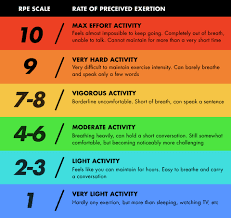
Photo 1
Parameters
- Intensity will be based on a rate of perceived exertion (RPE) out of 10 with 1 being very easy and 10 being max effort. Aim for an RPE of 2-3/10 for the first set. Your pump should increase as you perform the exercise. If you are not feeling the pump, increase the difficulty slightly.
- Occlusion pressure: 25-50%
- Start low and gradually increase
- Perform 3 sets of 30-45 seconds of spray board traversing (or regular wall traverse if you do not have a spray board) followed by 3 sets of laddering with feet on the wall. Work to rest ratio should be around 1 to 1. So if you’re on the wall for 30 seconds, rest for 30 seconds.
- Self select the edge size for laddering, however keep in mind the goal is to challenge the shoulders not the fingers.
- Progression for laddering: skip holds
- Regression for laddering: use bigger holds, don’t skip holds if you already are, or place feet on the floor touching the wall instead of on the wall.
Video 15: Spray Board
Caption: remember the focus is on your shoulder, so the movements should challenge your shoulder, not your fingers.
Video 16: Laddering
Caption: The climber is combining progressions and regressions for laddering. Choose one to perform at a time and progress/regress as necessary.
Lastly, if you are performing the movement exercises without BFR and have no pain or soreness, go ahead and try climbing on the wall again. I recommend starting low and going slow. The focus at the beginning should be to increase volume before intensity of climbing. BFR is a powerful tool for rehab and strength, but like any training method, it should be used strategically. If in doubt, consult a physical therapist to ensure a safe and effective return to climbing.
See a Doctor of Physical Therapy
Understanding and properly rehabilitating a shoulder injury can be difficult especially because it is a very complex joint. Physical Therapists (PT) are trained on effectively examining and evaluating the musculoskeletal and neuromuscular systems to determine a proper rehab program. If you continue to have pain, discomfort, and/or weakness, reach out to a local PT so they can help you get back on the right path to having fun and sending hard.
If you are able to reach out to a Physical Therapist who knows about rock climbing will likely be an even better choice. They will understand the specific demands of the sport and how they apply to your condition for a better solution to your treatment plan.
Author Bio
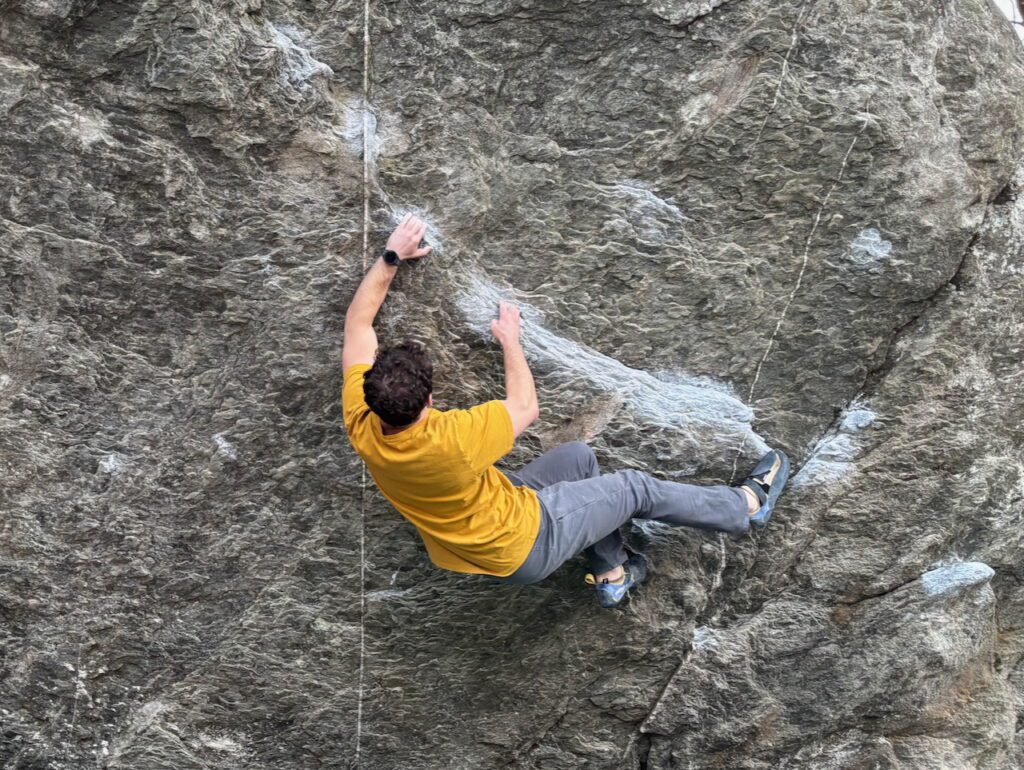
Jake Rosengarten is a Doctor of Physical Therapy student at the University of Elon in Burlington, North Carolina. He has been climbing for about 4 years now with a preference towards bouldering, but dabbles in the rope climbing scene occasionally. After school, he plans to dive deeper into climbing specific injuries to best help climbers rehab to return to the wall pain free. His contact information is below for any questions you may have.
Email: jrosengarten@elon.edu
Instagram: jake_climbs__
References
- Vanwye WR, Weatherholt AM, Mikesky AE. Blood Flow Restriction Training: Implementation into Clinical Practice. Int J Exerc Sci. 2017;10(5):649-654. Published 2017 Sep 1. doi:10.70252/LYGQ7085
- Patterson SD, Hughes L, Warmington S, et al. Blood Flow Restriction Exercise: Considerations of Methodology, Application, and Safety [published correction appears in Front Physiol. 2019 Oct 22;10:1332. doi: 10.3389/fphys.2019.01332]. Front Physiol. 2019;10:533. Published 2019 May 15. doi:10.3389/fphys.2019.00533
- Cognetti DJ, Sheean AJ, Owens JG. Blood Flow Restriction Therapy and Its Use for Rehabilitation and Return to Sport: Physiology, Application, and Guidelines for Implementation. Arthrosc Sports Med Rehabil. 2022;4(1):e71-e76. Published 2022 Jan 28. doi:10.1016/j.asmr.2021.09.025
- de Queiros VS, Dantas M, Neto GR, et al. Application and side effects of blood flow restriction technique: A cross-sectional questionnaire survey of professionals. Medicine (Baltimore). 2021;100(18):e25794. doi:10.1097/MD.0000000000025794
- Lum ZC, Park L. Rock climbing injuries and time to return to sport in the recreational climber. J Orthop. 2019;16(4):361-363. Published 2019 Apr 12. doi:10.1016/j.jor.2019.04.001
- Fabero-Garrido R, Gragera-Vela M, Del Corral T, Hernández-Martín M, Plaza-Manzano G, López-de-Uralde-Villanueva I. Effects of Low-Load Blood Flow Restriction Training on Muscle Anabolism Biomarkers and Thrombotic Biomarkers Compared with Traditional Training in Healthy Adults Older Than 60 Years: Systematic Review and Meta-Analysis. Life (Basel). 2024;14(3):411. Published 2024 Mar 20. doi:10.3390/life14030411
- Lambert B, Hedt C, Daum J, et al. Blood Flow Restriction Training for the Shoulder: A Case for Proximal Benefit. Am J Sports Med. 2021;49(10):2716-2728. doi:10.1177/03635465211017524
- Roehl T, Lambert BS, Ankersen J, Hernandez K, McCulloch PC, Hedt C. Optimal Blood Flow Restriction Occlusion Pressure for Shoulder Muscle Recruitment With Upper Extremity Exercise. Am J Sports Med. 2023;51(7):1859-1871. doi:10.1177/03635465231166959
- Bowman EN, Elshaar R, Milligan H, et al. Upper-extremity blood flow restriction: the proximal, distal, and contralateral effects-a randomized controlled trial. J Shoulder Elbow Surg. 2020;29(6):1267-1274. doi:10.1016/j.jse.2020.02.003
- Lambert BS, Hedt C, Ankersen JP, et al. Rotator cuff training with upper extremity blood flow restriction produces favorable adaptations in division IA collegiate pitchers: a randomized trial. J Shoulder Elbow Surg. 2023;32(6):e279-e292. doi:10.1016/j.jse.2023.02.116
- Chang CY, Torriani M, Huang AJ. Rock Climbing Injuries: Acute and Chronic Repetitive Trauma. Curr Probl Diagn Radiol. 2016;45(3):205-214. doi:10.1067/j.cpradiol.2015.07.003
- Hughes L, Paton B, Rosenblatt B, Gissane C, Patterson SD. Blood flow restriction training in clinical musculoskeletal rehabilitation: a systematic review and meta-analysis. Br J Sports Med. 2017;51(13):1003-1011. doi:10.1136/bjsports-2016-097071
- Cooper JD, Seiter MN, Ruzbarsky JJ, et al. Shoulder Pathology on Magnetic Resonance Imaging in Asymptomatic Elite-Level Rock Climbers. Orthop J Sports Med. 2022;10(2):23259671211073137. Published 2022 Feb 11. doi:10.1177/23259671211073137
- Bell ZW, Dankel SJ, Spitz RW, Chatakondi RN, Abe T, Loenneke JP. The Perceived Tightness Scale Does Not Provide Reliable Estimates of Blood Flow Restriction Pressure. J Sport Rehabil. 2019;29(4):516-518. Published 2019 Sep 24. doi:10.1123/jsr.2018-0439
- Disclaimer – The content here is designed for information & education purposes only and the content is not intended for medical advice.
Related Posts