One Legged Climbing: Should You Do It?
There’s no such thing as a casual rock climber; you love it or you’re indifferent. There’s just something about the sport that sucks you in. Maybe it’s the adrenaline rush from taking a whipper, the overwhelming satisfaction of sending your project, the zen when you feel your body is one with the wall. Whatever it is, one thing holds true: we are really, really bad at being injured.
I remember breaking my ankle like it was yesterday. I was only about six months into my climbing journey, carefully sneaking my way up a beautiful slab. I had the beta dialed. Mantle off the start. High left hand foot match. Shift weight over left foot. High right hand crimp. Match. I felt strong, solid. Until suddenly, my foot slipped off a cheeky little hold as I was reaching for the top of the wall. I pushed myself backward in a futile attempt to avoid cheese grating myself while losing all orientation I had while in the air. Next thing I knew, I landed on the side of my right foot from 10 feet up and was screaming in pain.
My first thought was “wow this hurts.” My second was “I’m not going to be able to climb for months.” And I knew one thing for sure: I was really, really bad at being injured.
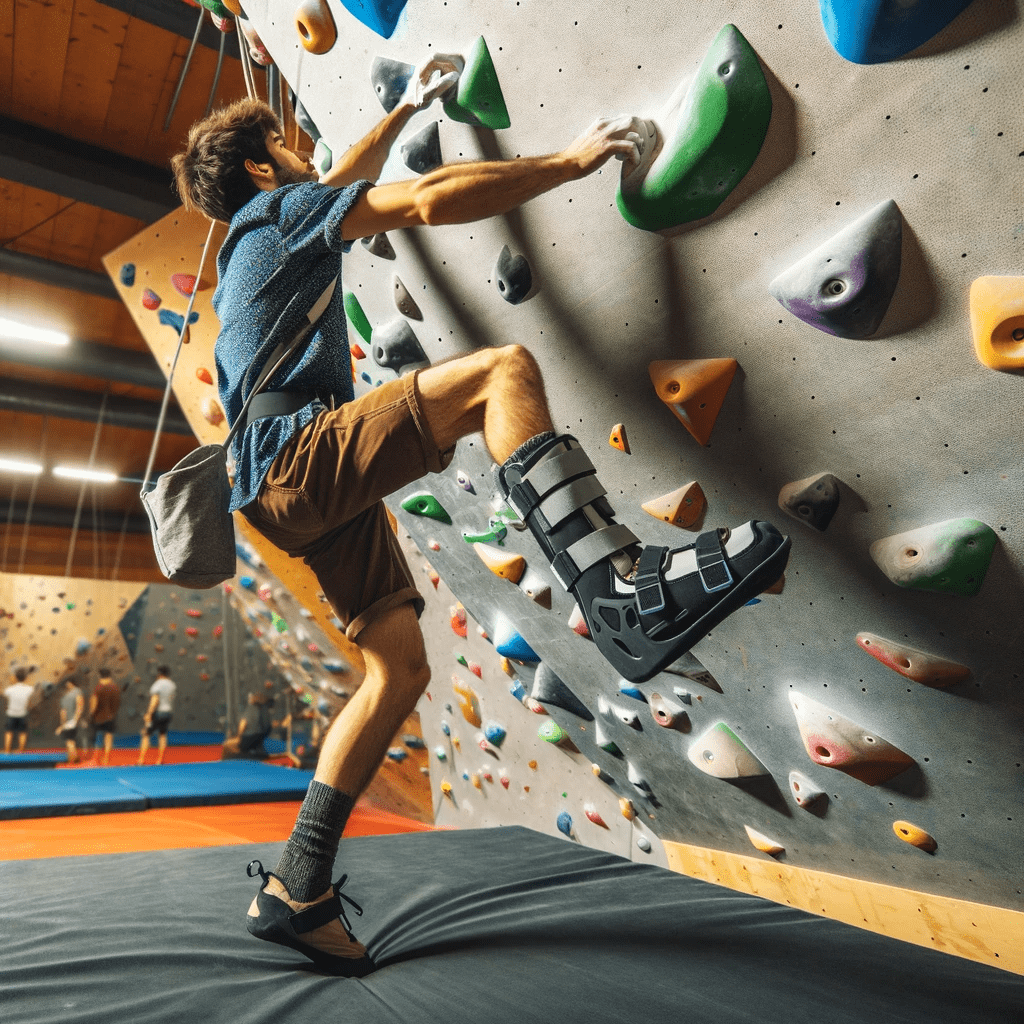
And I know I’m not the only one because I cannot even count the number of times I’ve seen climbers hobbling around the gym in a walking boot. Unable to fathom a life without climbing, they’re on top rope, making their way up the wall, one foot on the holds, the other dangling in the air below them. Not to mention the really intense climbers that have somehow managed to start bouldering in a walking boot.
We’ve all been there. We’ve all dreaded taking time off from the gym while we’re dealing with injury. We’ve all seen the climbers that decide they’re not going to. This raises the question: Should we be climbing one-legged with a lower body injury?
Bouldering vs. Lead vs. Top Rope

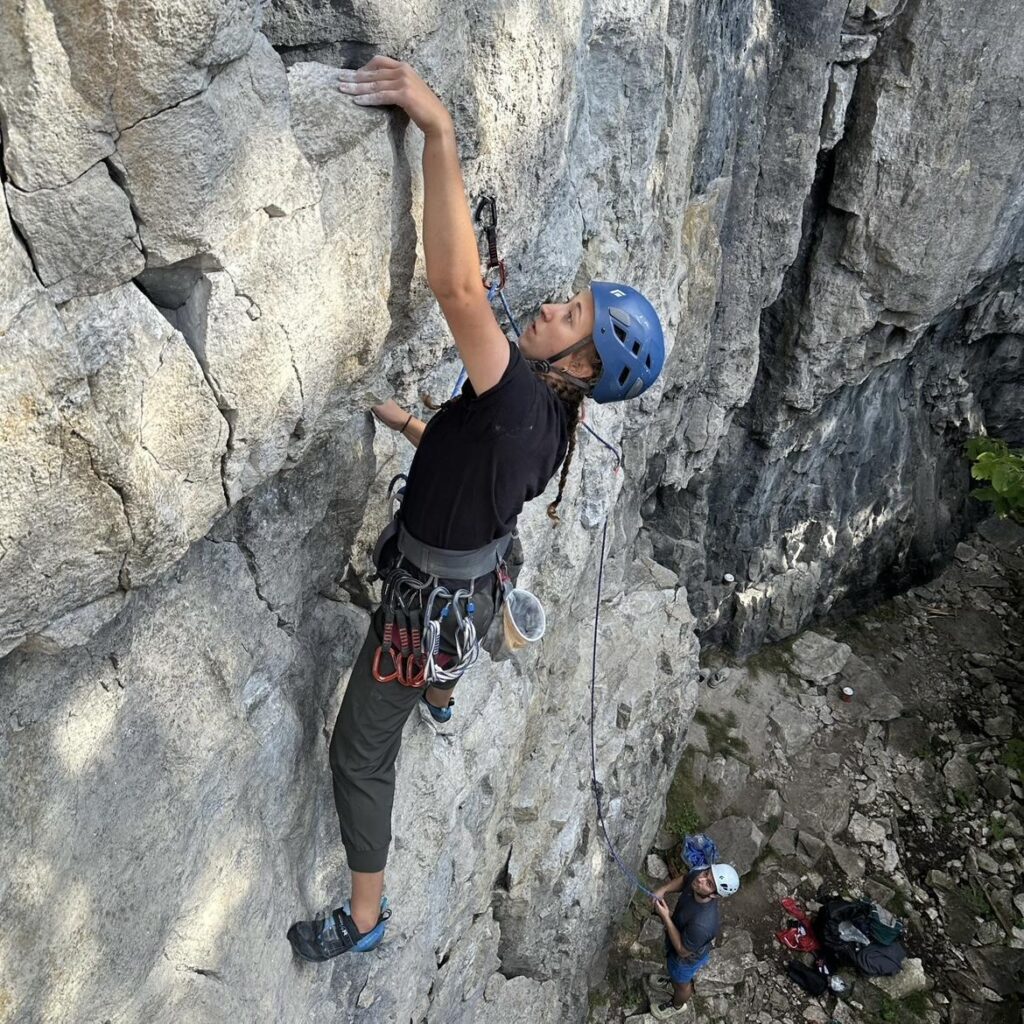

Before we get too deep into this discussion, we need to break down the different types of climbing. All climbing is not just climbing especially in the context of rehabbing an immobilized ankle injury.
Let’s talk about bouldering. Defined by climbers as over-gripping challenging holds while falling again, and again, this is a discipline of climbing where one scales 10-20-foot-tall boulders or indoor walls without protection. Every fall is a ground fall, cushioned by either large gym pads, or outdoor crash pads (imagine a mattress that you can carry on your back). With proper fall education and body awareness, I’d like to think bouldering is a fairly safe sport, but as injuries are a common place, my previously broken ankle might beg to differ.
Lead and top rope climbing are similar in the sense that you climb larger walls while attached to a rope. When top roping, the rope is threaded through an anchor system at the top of the wall, one side of the rope is tied to your harness, and the other is connected to your belayer through a belay device. As the climber moves up the wall, the belayer takes in slack. If the climber falls, they maintain their position on the wall since there isn’t any slack in the system.
Fall on top rope
Lead climbing is top roping on steroids. For this climbing discipline, the rope is on the ground, one end tied to the climber and the other to the belayer. As the climber ascends the wall, they place their own protection to clip the rope into. The belayer is feeding slack, until the climber takes a fall, when the belayer would take up slack. Since the climber is clipping into their own protection, the potential for larger falls is significantly greater. If the climber climbs above their last clip and falls, they’ll fall the distance to that clip, plus the slack the belayer left in the system, plus the amount of rope stretch.
In lead climbing, it’s also important to note the difference between a “soft” and “hard” catch. During a soft catch, the belayer attempts to lengthen the climber’s fall by hopping in the air. The climber has more time to spot their landing and are prevented from crashing too hard into the wall. Soft catches are usually the goal. Unless the climber is going to hit the ground, or a ledge, then you scratch that. A hard catch on the other hand, is when slack is pulled out of the system, and the length of the fall is shortened. But, as you could imagine, this will lead to the climber abruptly being slammed into the wall, forced to brace with whatever they can. Hard catches, although sometimes necessary, can hurt. No one likes being rattled by a hard catch.
Lead Soft Catch
Lead Hard Catch
So, why is this important?
When we’re climbing, we all accept a certain amount of risk. However, that amount of risk changes depending on the type of climbing we’re doing, especially when climbing immobilized. Falling is a part of the game. It’s inevitable. But with bouldering and lead climbing, the impact your body takes with every fall is significantly greater than with top roping. Getting caught with a hard catch on lead, causing your previously broken ankle to be bracing the impact is a lot more stress on your body than a light swing out from top rope. Keep that in mind.
Risks vs. Benefits
I’ve read the research, I’ve wracked my brain, I went back to the headspace I was in when I broke my ankle, and I’ve compiled an exhaustive list of risks and benefits to one-legged climbing. But, keep in mind, there isn’t a right or wrong answer for this discussion! Every single injury is different, so the decision to climb one-legged (or in a boot or however you decide is best for you) is one you need to make for yourself.
Benefits
Mental Health & Climbing
In recent years, the conversation surrounding mental health has become less taboo. More people are opening up about their struggles, and more research has been done about what truly impacts our mental health. One of the biggest findings is the impact of sports and exercise. Through an extensive literature search, it was found that “participation in sport of any form (team or individual) is beneficial for improving mental health and social outcomes amongst adults” (Eather et al., 2023). That includes improved psychological well-being, and lower ill-being, like reduced levels of depression, anxiety, and stress. I’m sure so many of us climb because it just feels good to be on the wall. It’s something we look forward to; it makes us happy.
You want the inside of your head to be a good place to live. Mood and self-talk are pertinent to achieve that. If climbing is the activity that truly makes you happy, if it gives you excitement to start your morning, it’s important.
Injuries can take a toll on our bodies physically and mentally. I remember having some really difficult days. Climbing one-legged can help mediate this. Of course, it’s not going to feel exactly like pre-injury, and may be frustrating in itself at times, but at the end of the day, you’re back on the wall doing what you love in the capacity that you’re able. That counts for something.
There isn’t much research about climbing specifically, but according to a study by Katharina Luttenberger in 2015, she found the “first evidence that therapeutic bouldering may offer an effective treatment for depression” (Luttenberger et al., 2015). She theorizes that climbing may be more beneficial than other sports due to bouldering focusing on mental aspects of activity more heavily than a sport like running. Combine this with the fact that climbers already get great enjoyment from climbing and it’s evident the positive impact climbing has on mental health.
Return to the mental game
One of the absolute hardest things for me (and many other climbers) when returning to climbing following my ankle injury was fear.
I knew recovering from an ankle injury was difficult. I knew how much effort it would take to make my ankle feel as normal as possible; I knew I was probably always going to have a little extra trouble with that side. But no one warned me how much this injury was going to affect my mentality while climbing. Taking a bad fall is a risk I accepted, but once an injury actually happens, it becomes real. And every single time I got on the wall in the early stages of my recovery, it was all I was thinking about. There was terror in falling and it was hard to overcome. But maybe what didn’t help, was the fact that between the time of my ankle injury to the 15 weeks later when I was cleared to boulder again (with heavy warning that I absolutely could not in any condition take a fall), I was nowhere near the wall. On top of the fear of injuring myself again, I felt much more cautious on the wall, making the return of my confidence more difficult.
Naturally, following a traumatic climbing injury, it’s going to take time to feel like yourself on the wall again. But the longer you wait, the more you psych yourself out. Getting back into climbing earlier (one-legged or not) rather than later, might make a huge difference in regard to comfort level on the wall.
Climbing Specific Strength maintenance
One of the biggest benefits to one-legged climbing is maintaining climbing specific strength. It’s becoming widely accepted that sport-specific training is the best way to improve at that sport. In a systematic review completed in 2023, there were mixed results on resistance training improving climbing. One study found “no significant improvements in finger grip strength following four weeks of isolated finger resistance-training” (Stien et al., 2023). Another study found that climbing specific endurance training (composed of hard and easy lead climbing) and hypertrophy training (composed of bouldering, campusing, and hard lead climbing) both improved lead climbing performances, but one was not better than the other. It’s evident that to be a better climber, you need to train through climbing. That could look like kilter training, hover drills on the wall, easy or hard lead climbing, or even endurance sets at your flash grade.
When we’re injured and take time off of climbing, what we begin to lose is our sport specific strength. By continuing to climb one-legged, although it’s likely easier than your project grade, you’re continuing to improve your specific strength. Your fingers are still pulling on small holds, you’re engaging your core when performing particularly reach-y moves, and you’re maintaining endurance with every move further up the wall. Though your injured ankle is going to need extensive rehabilitation before feeling normal again on the wall, your healthy leg, core, and upper body are still maintaining specific strength while recovering.
Risks
Overuse injuries
Let’s talk a little bit about biomechanics and force production. When you’re climbing, during most of the problem, you have three points of contact on the wall (two feet, and one hand while the other hand reaches to the next hold– and yes, smearing counts as a point of contact). Therefore, your feet are helping hold some of your body weight; force is more evenly distributed. Think about campusing. It’s so much harder because you’re only using your arms to hold up your entire body weight. That naturally puts more stress on your shoulders, wrists, and fingers. Prolonged stress over time can result in overuse injuries.
Now, let’s think about one-legged climbing. The idea of having three points of contact with the wall is eliminated since one leg is always going to be dangling in the air. That means while actually climbing, you’ll usually only have two points of contact on the wall, one healthy foot, and one hand. Therefore, your body weight is now distributed through those two points, putting significantly more stress on your upper extremity than you’re used to. An overuse injury waiting to happen. Or, even worse if you go a little too crazy pulling on some crimps, a pulley injury.
Obviously since an overuse injury happens over time, it’s difficult to pinpoint when or how it happens. I can’t say with one hundred percent certainty that the shoulder pain you feel after one-legged climbing is directly caused by that, but it’s not unlikely.
Overuse injuries are pesky and annoying; do you really want to risk being sidelined again or being unable to climb at your best once you’re fully recovered?
Re-injury
Everyone’s biggest fear: the dreaded re-injury.
One of the worst things is when you have an injury, you take time off to recover, and then suddenly either realize you came back too early, or pushed harder than you should’ve, and you reaggravate the same injury. It sets you back even further and the entire process starts all over again.
Imagine this scenario with a serious injury. The idea of re-injuring an ankle you just had surgery on for example, has much more severe consequences than aggravating a tweaky shoulder. Instead of a setback of a few days, this could be a setback of a few months, and potentially, an even worse injury than you started with. Damaging it further can result in another surgery, longer recovery time, and ultimately more time off the wall.
With that being said, it’s important to differentiate between falling from top rope and lead. Like I mentioned previously, a fall from top rope results in a nice gentle swing away from the wall. You’ll likely just be swinging in space, and there will be enough time to brace your return with the uninjured extremity. However, with lead, a fall can (and does very often) result in being slammed into the wall, regardless if it was a soft or hard catch. There’s significantly less time to react, and the fall distance is greater. Lead falls create inherently more risk.
How much are you really gaining?
Rehabilitation following any type of serious injury is a long road and beginning to climb without using that foot isn’t accelerating the rehab process. Sure, it’s fun in the short term and a way to continue climbing because you want to, but when the time comes when you can finally use the injured leg again, the fact that you’ve been climbing may not be as beneficial as you might think.
The actual rehab process is going to consist of strengthening, trying to make that foot feel like yours again, and learning how to trust your feet. The return is going to be limited and slow regardless of if you were climbing on it or not.
| PROS | CONS |
|---|---|
| Easier return to the mental game | Overuse injuries |
| Climbing specific strength maintenance | Increased risk of re-injury |
| Improved mental health | Limited improvement while injured |
Do the benefits outweigh the risks?
Ultimately, this decision is entirely up to you (and a trusted provider). Yes, climbing does wonders for mental health and you will maintain greater strength than if you stopped completely. However, is it worth running the risk of an overuse or re-injury?
Here are my two cents. If you choose to climb one-legged, do it on top rope in a boot. As discussed prior, bouldering or lead climbing is putting you at a much higher risk of taking a large fall and re-injuring yourself. And I can confidently say that isn’t worth it.
I want to end with this. I know that suffering a broken ankle (or similar lower body injury) might feel like the end of the world, like you’re never going to recover. I had some really hard days with some really hard physical therapy sessions where I was absolutely convinced my ankle wasn’t ever going to be the same again. But our bodies are resilient, and with proper rehabilitation, you’ll be back on the wall like you never left.
See a Doctor of Physical Therapy
Regardless of what you decide, it’s important to meet with a physical therapist for proper rehabilitation and guidance for your return to climbing.

Author Bio
I’m Emma St. Pierre, a doctorate of physical therapy student in my final year of schooling at the University at Buffalo! I’ve been an avid climber for about three years now.
Feel free to reach out with any questions:
emmastpi@buffalo.edu
Happy climbing!
Citations
- Eather, N., Wade, L., Pankowiak, A., & Eime, R. (2023). The impact of sports participation on mental health and social outcomes in adults: A systematic review and the ‘Mental Health Through Sport’ conceptual model. Systematic Reviews, 12(1). https://doi.org/10.1186/s13643-023-02264-8
- Luttenberger, K., Stelzer, E.-M., Först, S., Schopper, M., Kornhuber, J., & Book, S. (2015). Indoor rock climbing (bouldering) as a new treatment for depression: Study design of a waitlist-controlled randomized group Pilot Study and the first results. BMC Psychiatry, 15(1). https://doi.org/10.1186/s12888-015-0585-8
- Stien, N., Riiser, A., P. Shaw, M., Saeterbakken, A. H., & Andersen, V. (2023). Effects of climbing- and resistance-training on climbing-specific performance: A systematic review and meta-analysis. Biology of Sport, 40(1), 179–191. https://doi.org/10.5114/biolsport.2023.113295
- Disclaimer – The content here is designed for information & education purposes only and the content is not intended for medical advice.
Related Posts