Return to Rock Climbing After ACL Reconstruction
In this Rock Rehab Community lecture, physical therapists Jared Vagy and Sammi Iannucci join us to break down the first climbing-specific approach to returning to the wall after ACL reconstruction; drawing on the only two peer-reviewed papers on the topic, both of which are included at the bottom of this article.
The article covers why protocols built around cutting and sprinting don’t transfer to a sport defined by high steps, drop knees, heel hooks, and intentional falls, and what a climbing-specific alternative looks like in practice. Jared shares the background to the concept paper he developed with a group of orthopaedic surgeons, and Sammi walks through the case report she completed during her orthopaedic residency at USC, following a 50-year-old recreational climber from ACL rupture through to projecting, in a standard clinic with no climbing-specific equipment. Together they work through the six-phase, milestone-based protocol, the strength and functional testing that governs progression, the role of psychological readiness, and how drop hang testing can be used to both measure and train a climber’s ability to land, fall, and roll.
Topics Covered:
- Why field- and court-sport ACL protocols don’t transfer to climbing
- Climbing as a high-impact rotational landing sport and its ACL injury risk
- Case presentation: a 50-year-old recreational climber, reconstructed via Achilles tendon allograft
- The six-phase, milestone-based return-to-climb protocol
- Strength and functional testing: dynamometry, adapted Grant foot raise, high-step pull, hop testing
- Drop hang testing for landing, falling, and rolling
- Psychological readiness and the ACL-RSI
- Staged fall progressions, return to bouldering, and the lead fall test
- Progressing from top roping to projecting, and the three-year strengthening window
Presenter Introduction
Jared Vagy, a physical therapist based in Los Angeles, developed the ACLR return-to-climb protocol alongside a group of orthopaedic surgeons. Sammi Iannucci, a physical therapist now based in Ventura, applied that protocol during her orthopaedic residency at USC and submitted the case to JOSPT. She followed the patient for roughly nine months, and notes that the clinic she worked in had no hangboards, no climbing wall, and no dedicated space — the protocol does not require a specialist facility.

The Gap in the Current Literature
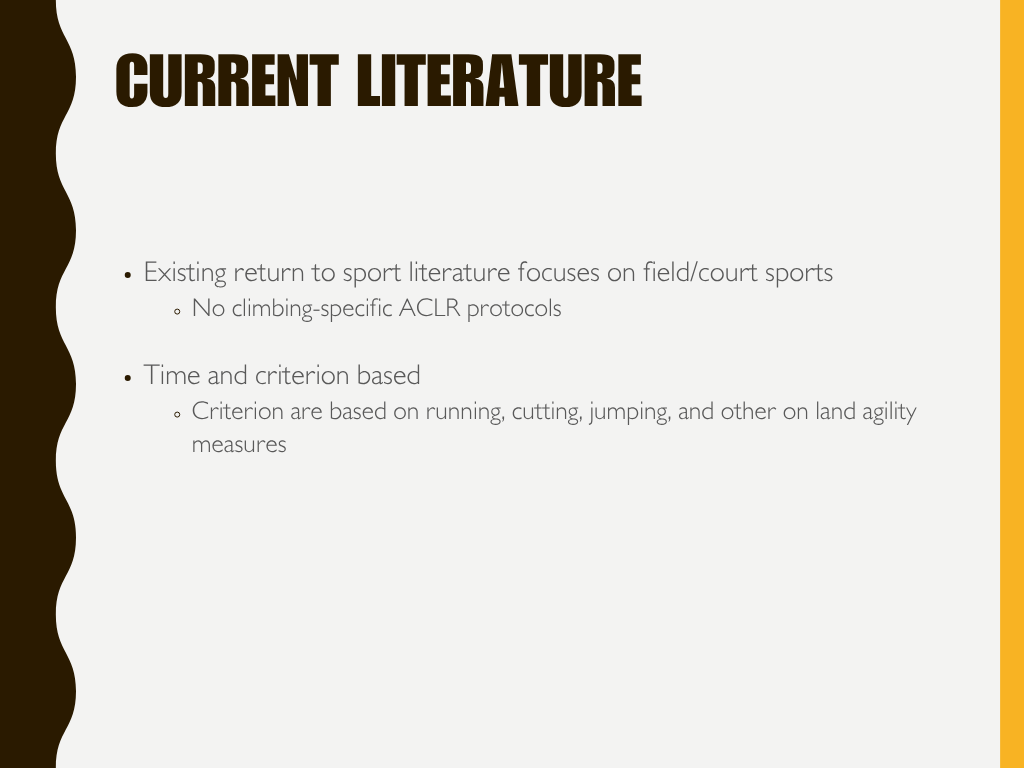
Return-to-sport literature is built almost entirely around field and court sports, and no climbing-specific ACLR protocol exists. Current recommendations are both time- and criterion-based, which this protocol retains — but the published criteria measure running, cutting, and jumping. None of them reflect what a climber actually returns to.
Why Climbing Needs Its Own Approach
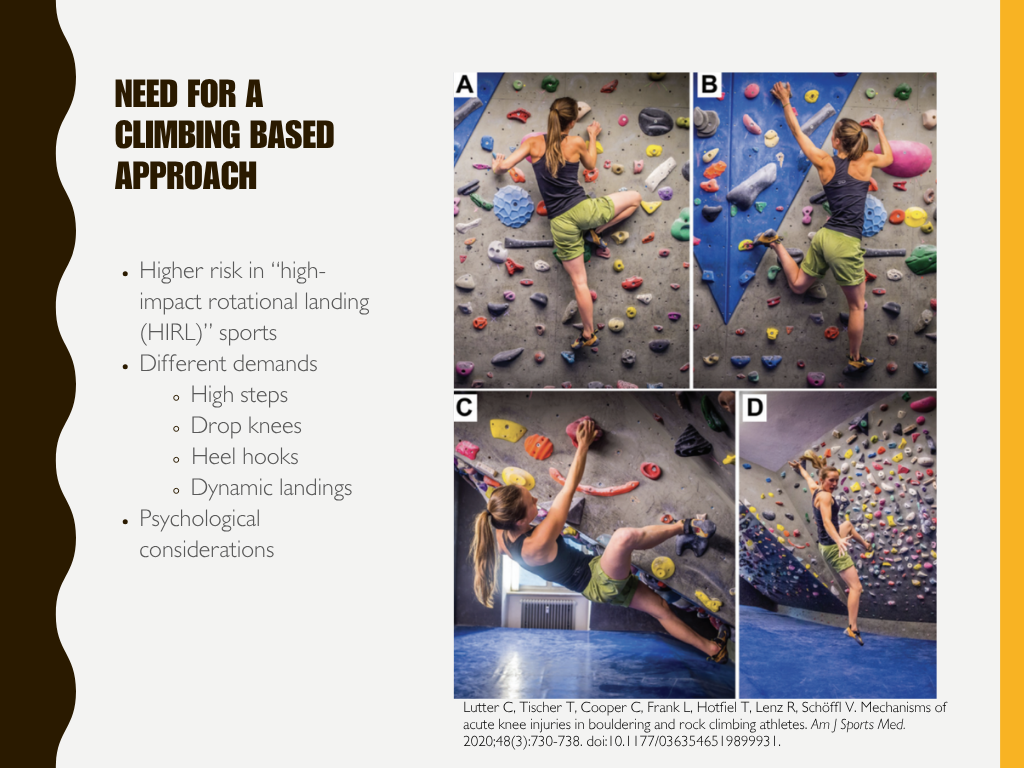
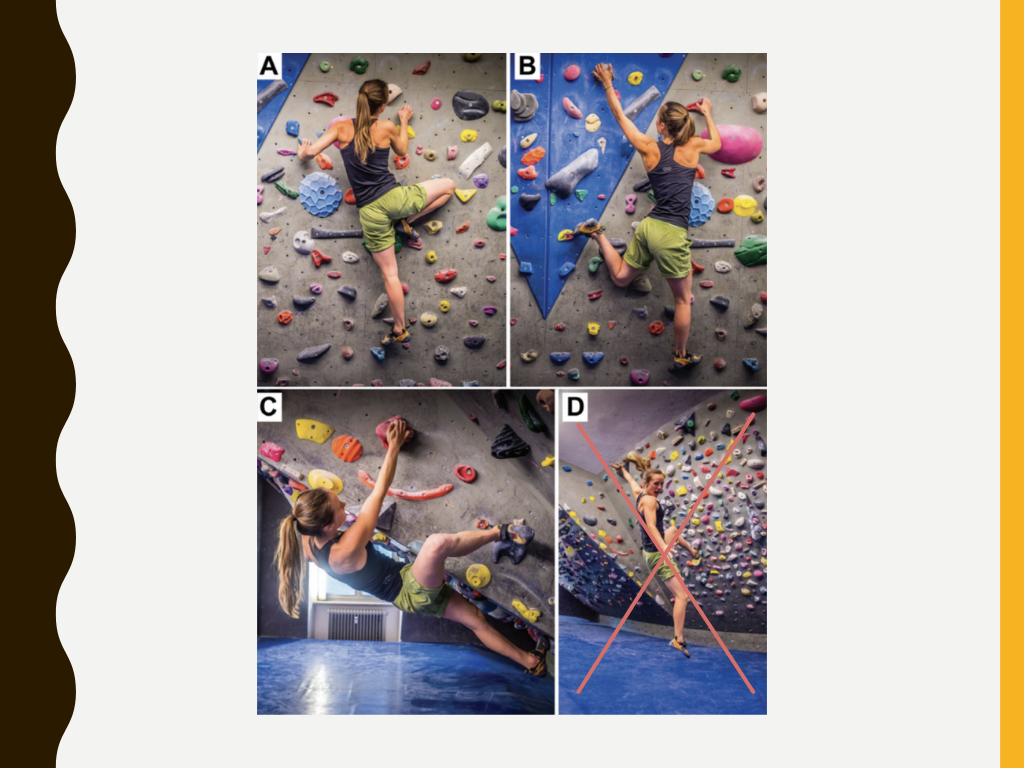
Climbing sits in a category Montalvo et al. describe as “high-impact rotational landing” — non-contact sports involving high-impact landings from fixed objects. The category carries a higher ACL injury risk than collision sports like football or contact sports like soccer and basketball. The figure shows the movements that load the climber’s knee: high steps, drop knees, and heel hooks. But in the mechanism study it comes from, every ACL injury observed arose from the fourth panel — a fall. Traditional rehabilitation prepares athletes to cut and sprint; climbers do neither. Psychological factors matter here too, particularly when the injury happened while climbing, and this protocol measures them rather than simply acknowledging them.
The Case: A Recreational Climber With an ACL Rupture
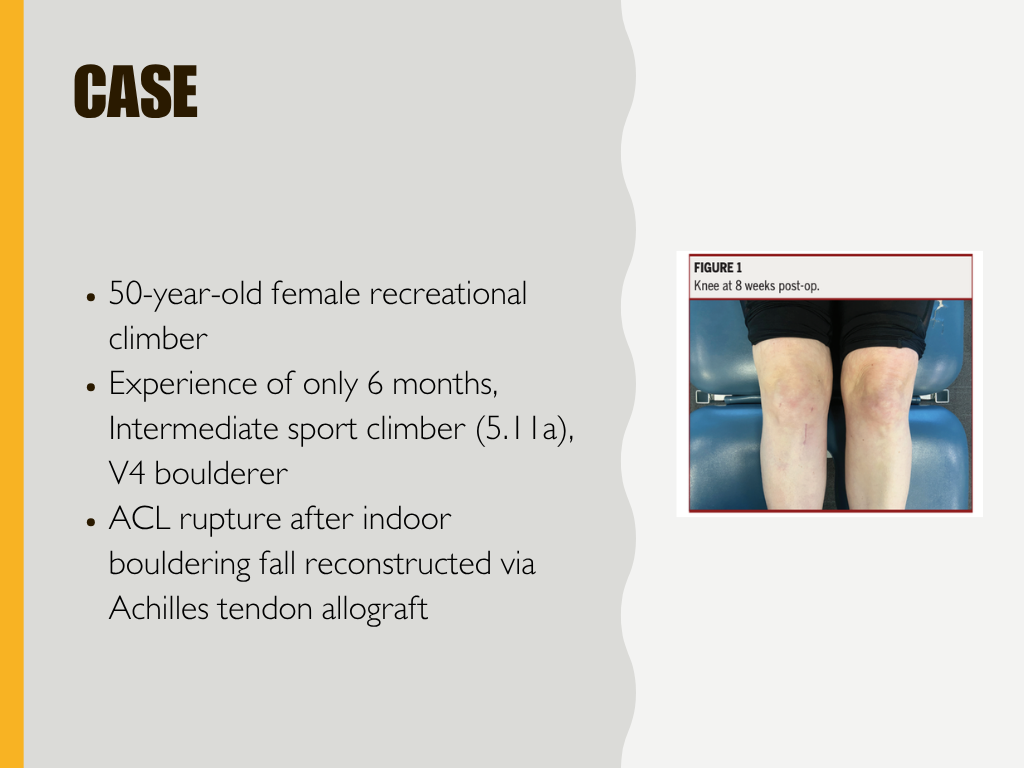
The patient is a 50-year-old female recreational climber with six months of experience — an intermediate sport climber at 5.11a and a boulderer at V4, who mainly bouldered. She ruptured her ACL landing awkwardly from an indoor bouldering fall, and the ligament was reconstructed with an Achilles tendon allograft.
Timeline From Injury to Return
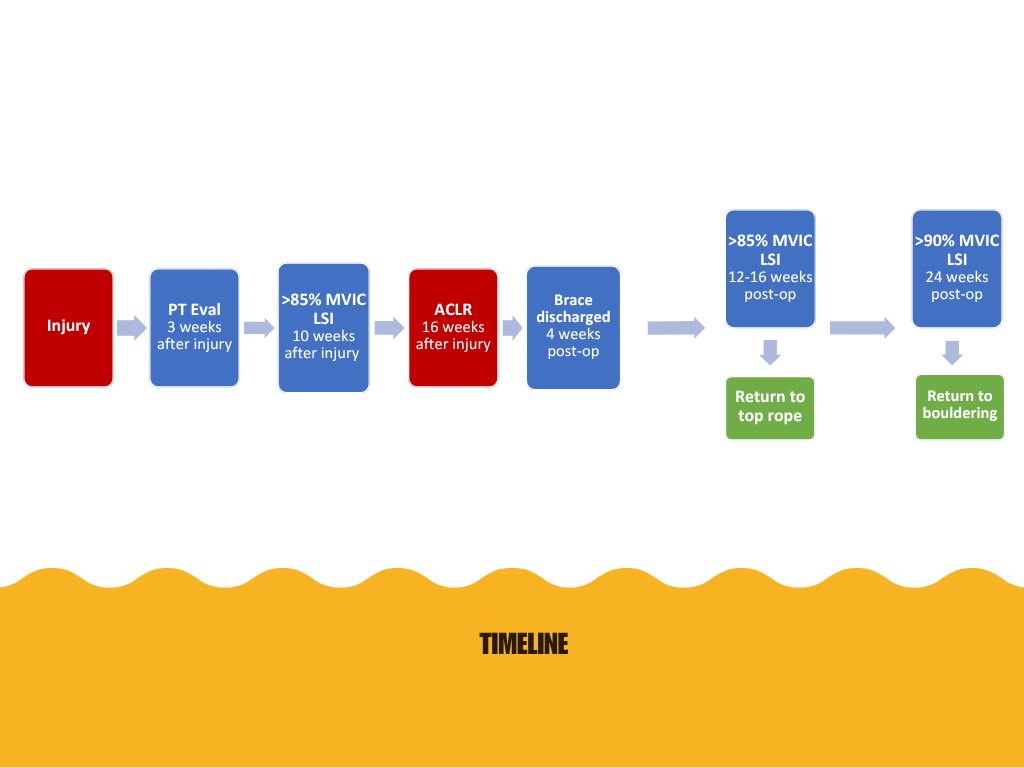
She reached physical therapy three weeks after the injury and initially pursued conservative management, expecting to avoid surgery. By ten weeks she had climbed back above 85% MVIC limb symmetry index and was functioning well day to day, but an intermittent feeling of instability in the knee led her to proceed with reconstruction at sixteen weeks post-injury. The brace was discharged four weeks after surgery. She returned to top rope after reaching greater than 85% MVIC LSI at 12–16 weeks post-op, and to bouldering upon reaching greater than 90% at 24 weeks.
The Six-Phase Return to Sport Protocol
The protocol runs across six phases. Progression is governed by milestones rather than the calendar alone, though minimum timeframes apply at each stage to stop a motivated climber from advancing too quickly.
Phase I: Early Post-Op (0–4 Weeks)
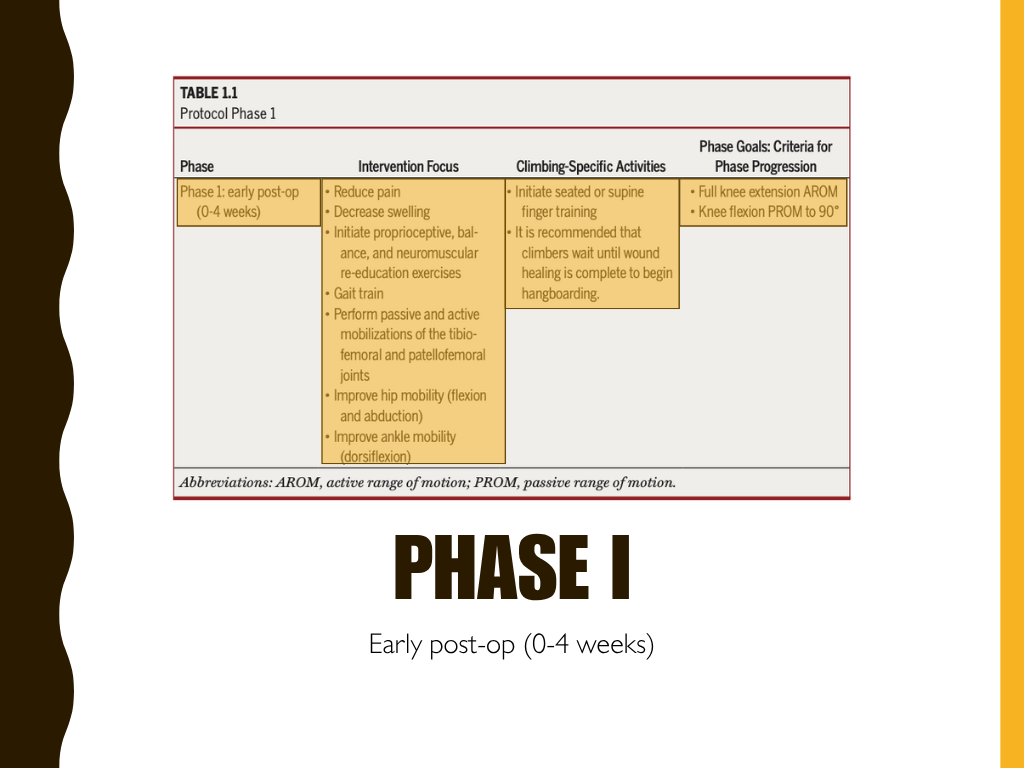
The first four weeks look much like early rehabilitation for any other athlete: reducing pain, controlling swelling, restoring range of motion, gait training, and early balance and neuromuscular work. The climbing-specific addition is finger training, performed seated or supine — climbers are advised to wait until the wound has fully healed before hanging. The phase closes on full active knee extension and passive flexion to 90 degrees.
Phase II: Late Post-Op (4–8 Weeks)
Range of motion continues to improve while conditioning begins in earnest, and the first climbing-specific movements enter the programme: hanging shoulder girdle work, hamstring strengthening for the heel hook position, and high-step training starting at 10 centimetres. Technique is the priority over load. This patient progressed quickly — an allograft carries no donor site, so no quadriceps or hamstring tendon was harvested — but she was still held to the minimum time in each phase rather than allowed to advance on milestones alone.

Testing at Eight Weeks
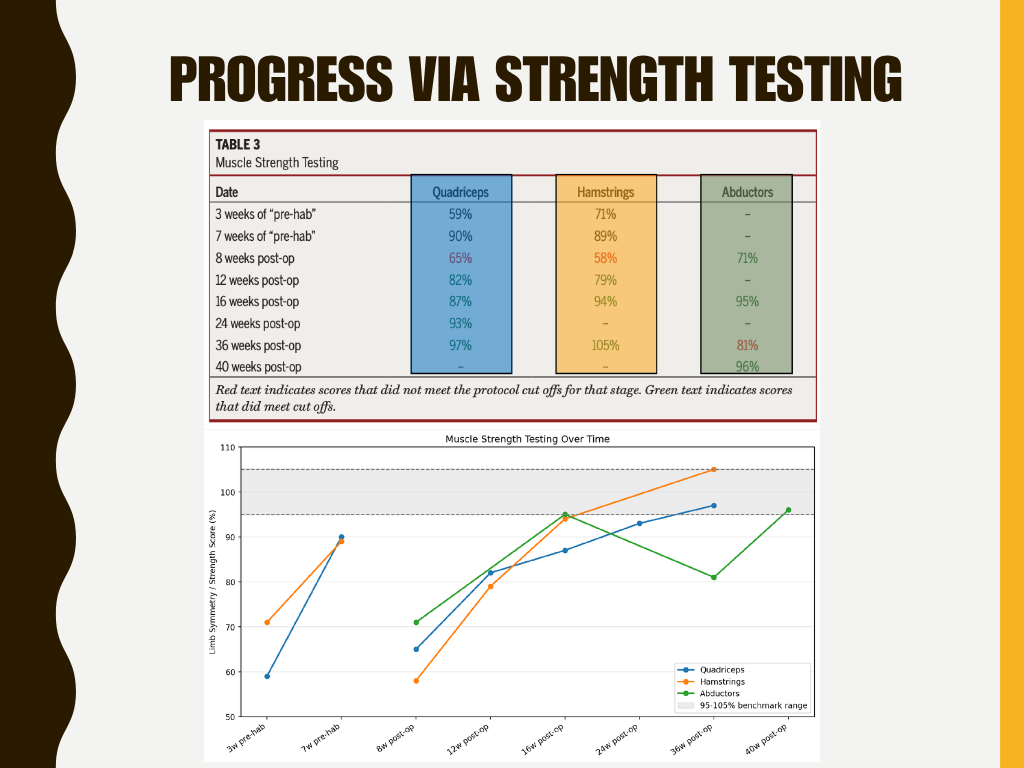
Objective testing anchors progression. The battery includes a step up with upper extremity assist, the adapted Grant foot raise, and dynamometry for the quadriceps, hamstrings, and hip abductors. Strength is measured with a tension-based dynamometer rigged to the plinth with a mobilisation belt, carabiners, and an ankle strap — accessible equipment rather than a laboratory setup. At eight weeks this patient had not yet reached the 70% MVIC LSI required to advance, so she remained in Phase II and was retested at twelve weeks, where she passed.

Phase III: Early Strengthening (8–16 Weeks)
Phase III is the first time back on the wall — top roping three grades below her estimated ability, on a top rope where falls are unlikely, with a minimum of twelve weeks post-op. Load increases gradually alongside it. She was cleared at twelve weeks but did not get back into the gym until sixteen, purely because her schedule did not allow it. Progression out of this phase requires 80% limb symmetry on dynamometry and single-leg squat repetitions, plus Y-Balance within range.

Phase IV: Late Strengthening (16–24 Weeks)
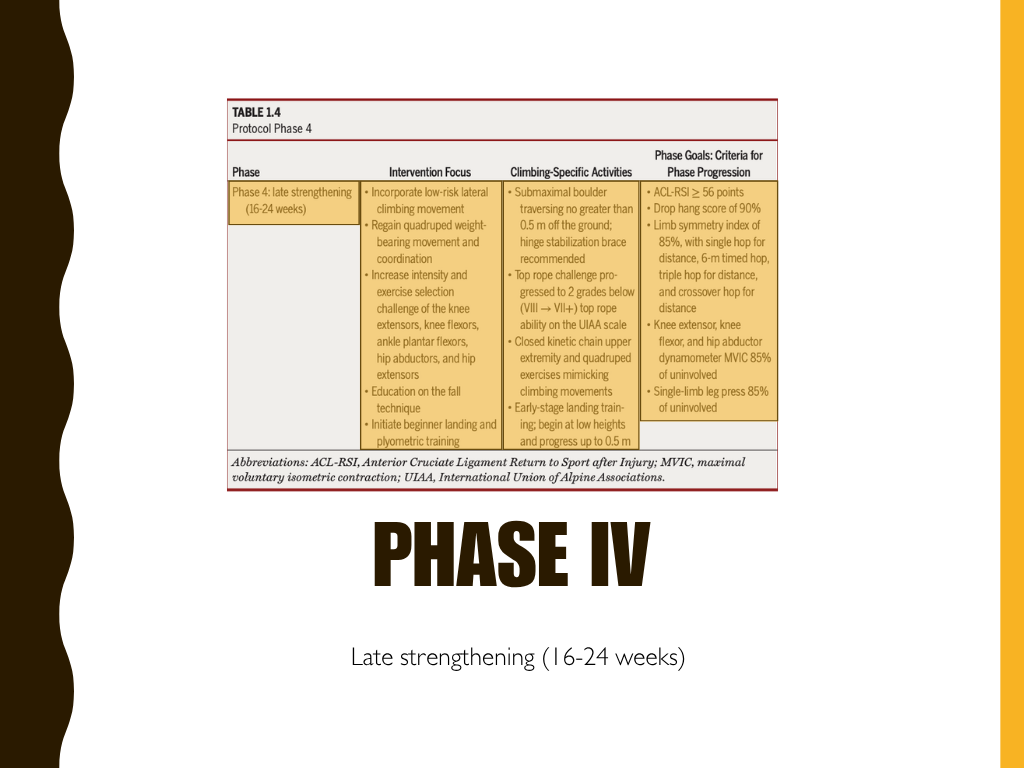
Landing enters the programme for the first time, along with plyometrics — but not falling from height. Boulder traversing at roughly half a metre off the ground is encouraged; this patient’s gym was too crowded and wasn’t set up for it, so she skipped it and continued on top rope, now progressed to two grades below. Two new measures appear here: the ACL-RSI for psychological readiness, and the drop hang score.
Drop Hang Testing
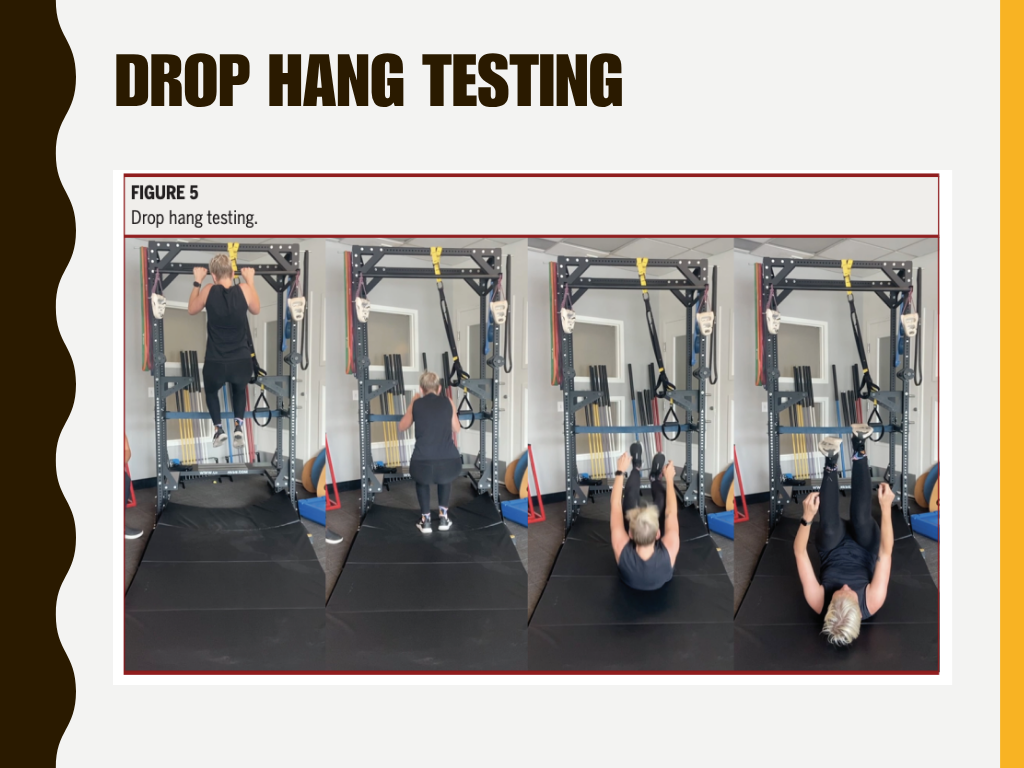
Drop hang testing is the climber’s demonstration, in the clinic, that they can land, fall, and roll. The climber hangs from a pull-up bar with their feet around two feet from the pad, releases, and lands. Each drop is scored on four criteria — knee flexion to at least 90 degrees, no dynamic knee valgus, landing in the indicated foot position, and rolling onto the backside rather than putting the hands down. Five drops across three foot positions gives a 20-point total, and 90% is required before returning to bouldering. The test doubles as training: reps can be logged from a semi-pull-up position in a fully controlled environment.
Phase V: Return to Sport (24–36 Weeks)
Bouldering returns, but only as purposeful falls — easy routes well within ability, where the climber stays in control. Rather than jumping from the top, she climbed down to two feet before dropping, then three, then four. Lead climbing begins three grades below current top rope ability. Landing mechanics are refined throughout, and the full battery is retested: ACL-RSI, hop testing, leg press, and dynamometry.

Purposeful Falls, Not Uncontrolled Ones
The distinction that governs this phase. Heel hooks, high steps, and drop knees are reintroduced deliberately and under the climber’s control; the uncontrolled fall to the ground stays off the table until landing capacity has been demonstrated.
Phase VI: Return to Performance (36+ Weeks)
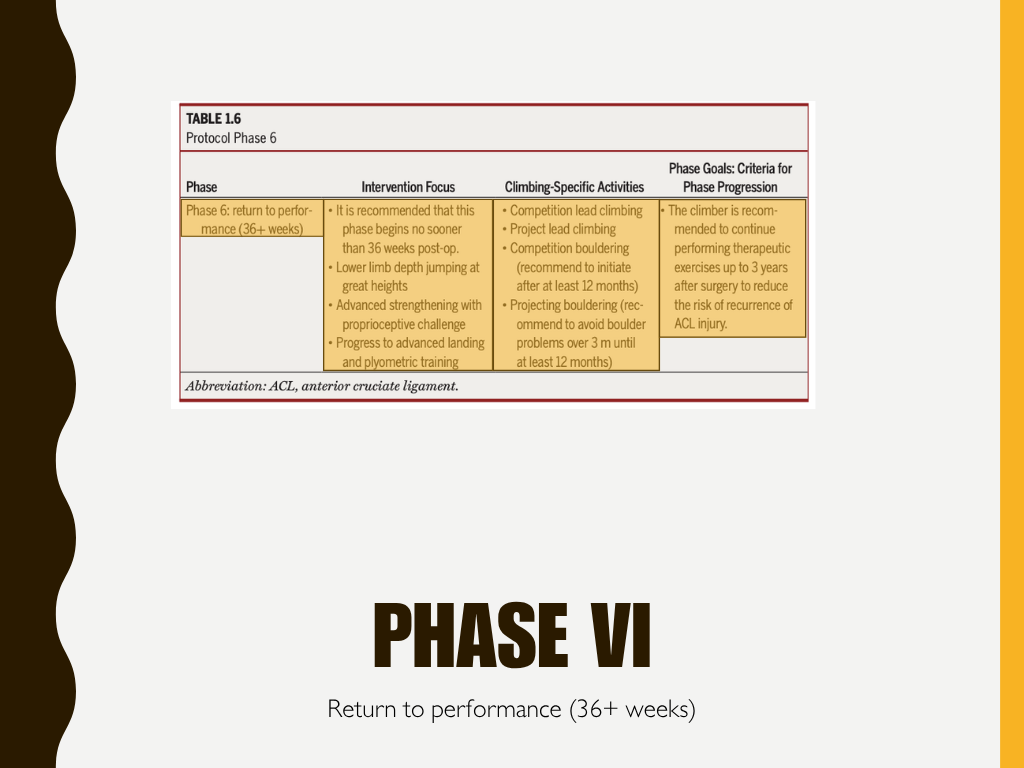
From 36 weeks onward, uncontrolled falls are added back and the climber returns to projecting, supported by advanced strengthening and landing training. This is the final step in bridging the gap between controlled rehabilitation and climbing at limit.
Progress via Self-Report Measures
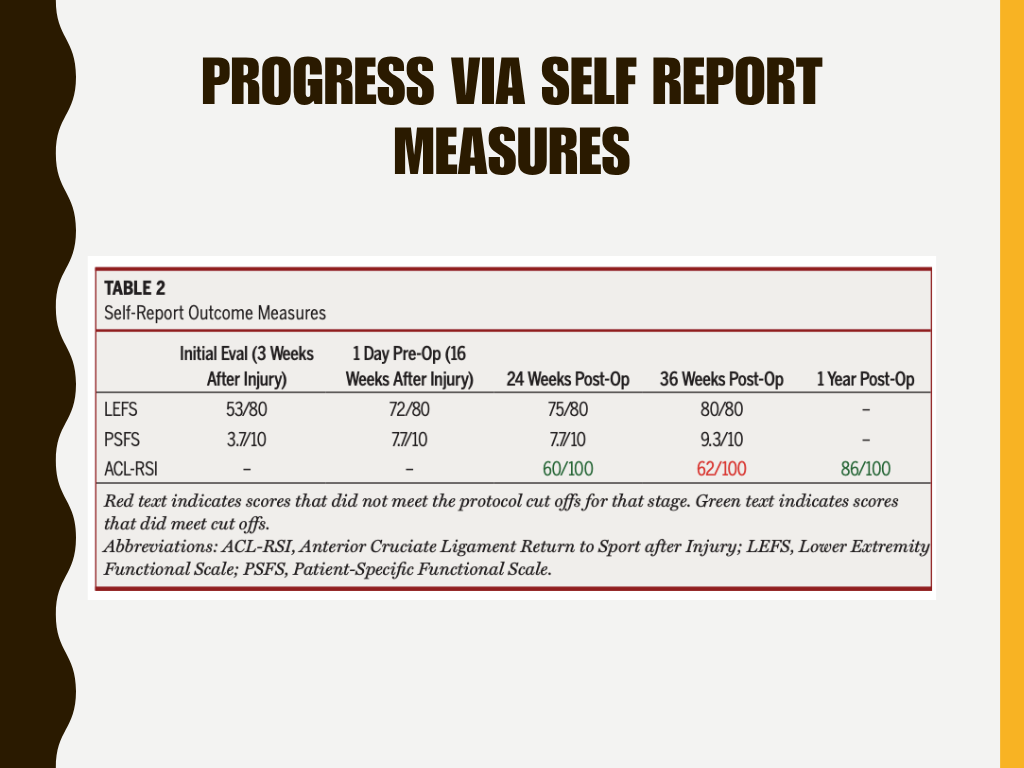
Three measures tracked her perception of function and confidence. The Lower Extremity Functional Scale and Patient-Specific Functional Scale both improved steadily. The ACL-RSI, which assesses psychological readiness, lagged behind — it sat below the protocol’s cut-off at 36 weeks, so it was readministered at one year, by which point several more months of climbing had brought it up and she was visibly more confident.
Progress via Strength Testing
Serial dynamometry for the quadriceps, hamstrings, and hip abductors documents limb symmetry closing across the protocol. The one checkpoint she missed was at eight weeks; from twelve weeks onward she met every subsequent requirement — 80% to enter Phase IV, 85% to enter Phase V.
Progress via Functional Outcome Measures
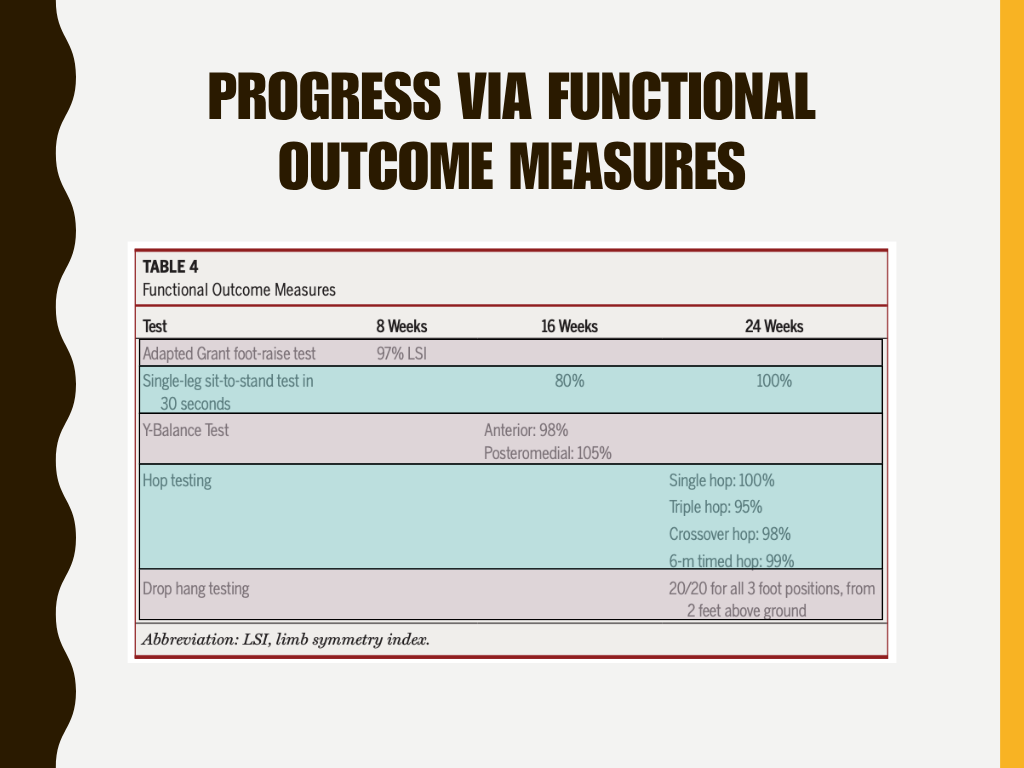
The climbing-relevant tests round out the picture. The adapted Grant foot raise was near symmetrical and needed no retest. Single-leg sit-to-stand was retested until it reached full symmetry. Y-Balance, hop testing, and drop hang testing all came back strong.
Return-to-Sport Timeline Recap
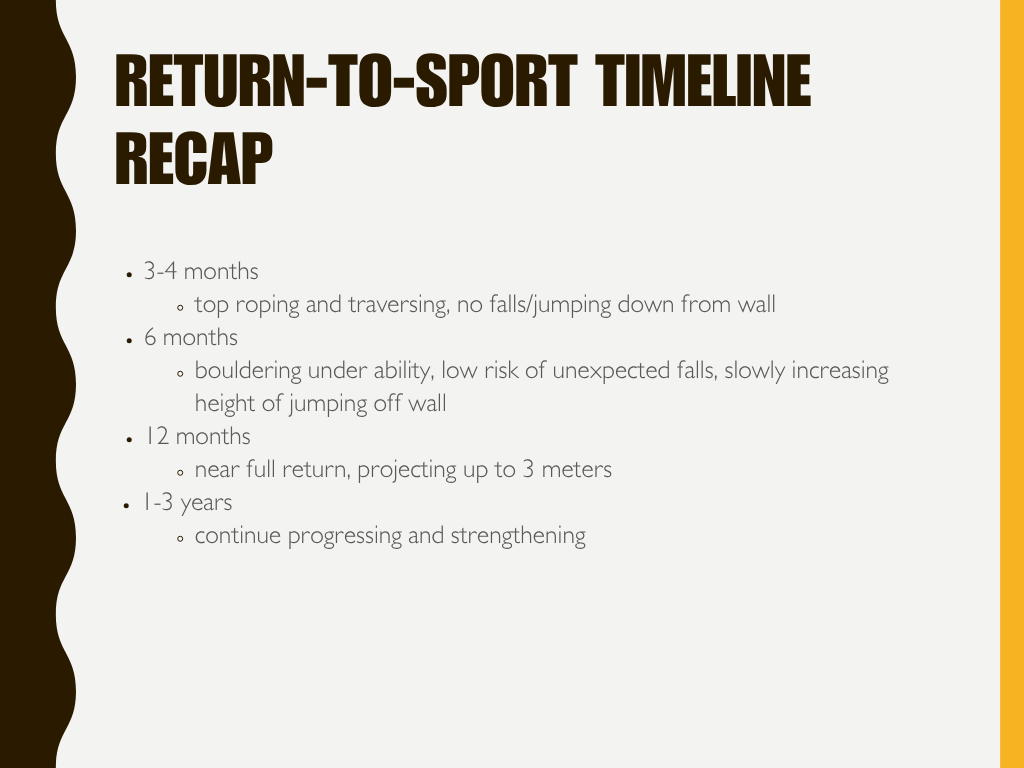
Condensed into practical terms: at three to four months, top roping and traversing with no falls and no jumping down from the wall. At six months, bouldering under ability where unexpected falls are unlikely, slowly increasing the height of jumping off the wall. At twelve months, near full return, projecting up to three metres. From one to three years, continued progression and strengthening — the recommendation is to keep training for up to three years post-surgery to reduce the risk of reinjury.
Questions
An opportunity for discussion, clarification, and application of the protocol to real-world climbing scenarios.
Clinical Pearls From the Discussion
Following the case presentation, Jared shared several practical points drawn from using the protocol in his own clinic.
The early phases are underestimated. With serious climbers, Phases I and II are the window for shoulder girdle strength and finger work. Climbers get bummed out that they can’t get on the wall, and this is the moment to redirect that energy usefully. It pays off later: by twelve weeks, when they start top roping and progressively climbing harder, strong fingers keep them from attempting things outside their capacity.
Get closer to the sport than feels necessary. The published heel hook progression runs through a series of standard PT exercises, and the later ones resemble a heel hook without really being one. Rotating the hip into external rotation and varying the angles gets much closer to how the movement actually looks on the wall — that final step is where sport-specific training genuinely begins.
Test the legs on their own. The high step and pull test uses a TRX strap deliberately, because climbers unload through their upper body on the wall. But the legs also have to work unassisted, which is why the criteria pair the assisted test with the ability to ascend stairs skipping a step — vertical gain from the lower extremity alone.
Education is the crux of returning to bouldering. Returning a climber safely to falling remains the hardest part of the process. The concept paper includes commissioned illustrations of falling backwards and sideways specifically so that novice climbers can see how it’s done, rather than being told.
The lead fall test is deliberately simple. An earlier, more complicated version was stripped back to what amounts to the lead fall check a gym would use to recertify a climber. It follows the ACL-RSI, which does the psychological preparation first. The criteria cover hip and knee flexion angle, identifying the fall zone, and keeping the rope between the climber and the wall — plus an exhale on release, which Jared notes candidly was partly there to round the scale to 20 points.
It’s a protocol, not a prescription. It took a great deal of work and it isn’t perfect, but it holds up in practice. Clinicians are encouraged to use their own judgment and progress the climber faster or slower as the individual warrants.
The Research Behind the Protocol
See below for the two peer-reviewed papers behind this lecture — currently the only published research on returning to rock climbing after an ACL injury:
Anterior Cruciate Ligament Rehabilitation and Return to Sport in Rock Climbing Athletes: A Practical Concept Paper
This peer reviewed paper by Vagy et al. proposes a six-phase rehabilitation and return to sport protocol for climbers following ACL reconstruction, developed by a physical therapist alongside a group of orthopaedic surgeons. It follows the stages of a standard post-operative ACL protocol but adds the demands specific to climbing, such as eccentric landing mechanics and penduluming into the wall during a lead fall. It also introduces two climbing-specific return to sport tests — the drop hang test and the lead fall test — along with the criteria for progressing through each phase. This paper is the foundation the case report was built on.
Fullscreen ModeReturn to Rock Climbing After ACL Reconstruction: A Case Report
This peer reviewed case report by Vagy and Iannucci applies the protocol to a 50-year-old recreational climber who ruptured her ACL in an indoor bouldering fall. It follows her from three weeks after injury through to a full return to her prior climbing level at one year, using self-report questionnaires, dynamometry, and climbing-specific performance tests to guide each progression. It is the first published account of the protocol in practice, and demonstrates that it can be delivered in a standard clinic without climbing-specific equipment.
Fullscreen ModeReferences
- Lutter C, Tischer T, Cooper C, Frank L, Hotfiel T, Lenz R, Schöffl V. Mechanisms of acute knee injuries in bouldering and rock climbing athletes. Am J Sports Med. 2020;48(3):730-738.
- Montalvo AM, Schneider DK, Webster KE, et al. Anterior cruciate ligament injury risk in sport: a systematic review and meta-analysis of injury incidence by sex and sport classification. J Athl Train. 2019;54:472-482.
- Vagy J, Schöffl V, Ohde J, Petersen W, Lutter C. Anterior cruciate ligament rehabilitation and return to sport in rock climbing athletes: a practical concept paper. Front Sports Act Living. 2025;7:1580509.
- Vagy J, Iannucci S. Return to rock climbing after ACL reconstruction: a case report. JOSPT Cases. 2025;5(3):138-155.
- Disclaimer – The content here is designed for information & education purposes only and the content is not intended for medical advice.
Related Posts