Feel Your Feet: Building Better Ankle Proprioception for Climbers
Picture this: You’re at your home crag with your new climbing friend and about to show them your long-term slab project. This slab is your nemesis, The crux involves horrible foot holds, nothing for your hands, and your feet keep slipping off the boulder. You show your friend the beta and fall off like you have the last 50 attempts. Then your friend gives it a try, and you’re shocked: The crux looked like a walk in the park. So, your friend flashes your project, and you have no choice but to congratulate this amazing effort. Still, you can’t understand how it went so easy, and what was different from your countless tries. Fair enough, your friend may be better than you at slab climbing, but you both are the same height, have the same shape, climb the same grade indoors, and use the exact same beta. Why on earth can’t you do the same moves on this boulder? What does your friend have that you don’t? If you recognize yourself in this seemingly unfair situation, keep reading, because the answer may be ankle proprioception.
What’s the role of ankle proprioception in climbing and who can benefit from this?
Proprioception is a complex construct and no consensus definition exists in the literature. Let’s keep it as simple as possible while keeping it up-to-date and comprehensive: According to Han et al., proprioception is the ability to detect the position and movement of any part of your limbs, by integrating mechanical stimuli perceived by your body1. Concretely, it tells you whether you’re in a good position or moving effectively while climbing. Moreover, we know that proprioception plays a crucial role in balance, alongside other sensory inputs such as vision and touch2. This is why you don’t fall when you stand up with your eyes closed, for example. Studies have shown that balance and proprioception, especially at the ankle, are key components of sports performance, including climbing2-3-4.
What does the ankle proprioception (AP) have to do with climbing? Well, AP is omnipresent in rock climbing, involving, among other things, precise footwork, often in blind conditions, and dynamic movements like dynos5. Also, AP is linked with altered landing, which is quite frequent in climbing6. Think of landing with your feet on a hold after a lache or, even more often, on an unstable surface such as a crashpad.
Different causes can lead to an AP deficit including ankle sprains and chronic ankle instability (CAI)5-6-7-8. Concerning acute injuries, such as ankle sprains, it is best to consult a qualified health practitioner (e.g. a physical therapist) to get a proper diagnosis and treatment as soon as possible. This article will focus on the later phases of the rehabilitation process after an acute ankle injury and on more chronic stability disorders, where proprioceptive training is recommended5-7.
Thus, who can benefit from better AP? The answer is pretty much everybody. Suppose you suffered an ankle injury and unloaded it by reducing the painful activities or movements to allow it to heal and are now progressively reloading it. In that case, adding proprioception training to your program might be good. Whether recovering from an acute ankle injury, dealing with CAI, or you’re frustrated you can’t send your project like the climber in the Introduction, proprioception training may help increase performance2, dynamic postural stability, and self-perceived stability7, and can reduce ankle injury risk2.
Assessment of (climbing-specific) ankle proprioception
First, there are some questions you can ask yourself to have a quick idea of whether your AP needs to be addressed and how it reflects in your climbing. Here is a short list of reflections:
- Are there any movements you avoid while climbing? Can you explain why (e.g. fear of falling/getting hurt, feeling of instability…)?
- Do you have a previo*us history of ankle injury/instability?
- When you fall (because most of us fall more than we send), can you control the landing, and do you apprehend falling?
- Do you report imbalances or unexpected slips while climbing?
There are also some physical tests you can perform to assess AP, and you can also use them to track your progress.
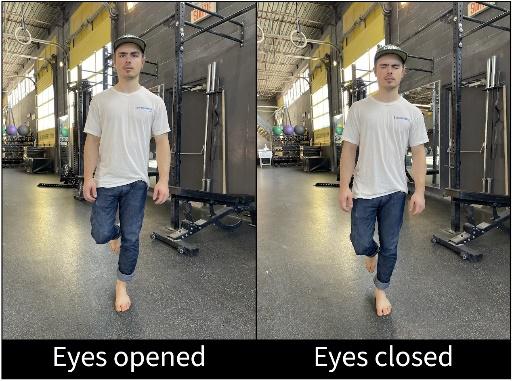
One Leg Stance (or Single Leg Stance) Test7
- Start on your good leg, eyes opened, hands on hips, barefoot and unsupported.
- Start a timer when your foot leaves the ground.
- Stop it when your foot lands on the ground or your arms leave the test position.
- Repeat with the other leg.
- Repeat all steps with your eyes closed.
Tips: Filming yourself helps highlight imbalances during the test (e.g. toes gripping the floor), and to track your progress. You can also compare your legs with each other.
Normative Values: ≃ 45 sec eyes opened; 10 sec eyes closed (18-39 y/o, general population)9.
Climbing-Specific Progression: While climbing, we rarely use the whole surface of our feet on the holds, so let’s try it with your heel slightly raised and a small bend of the knee. Keep it controlled, so try to avoid toe-gripping and wobbling at the ankle, and keep your knee aligned with your 2nd toe (e.g. the one next to your big toe). Once controlled and easy, try it with your climbing shoes!

Star Excursion Balance Test (SEBT)7
To perform this test, you need a roll of tape, a measuring tape, two marker pens of different colors, and ideally a friend to help you with measurements.
- Place four tape strips on the ground that meet in the middle to form 45-degree angles.
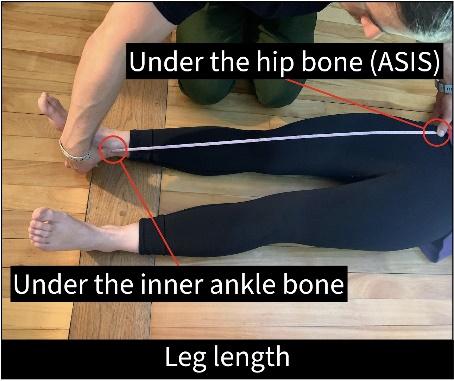
2. Have your friend measure your leg length on each side while you lie on your back.
3. Start standing on your good leg at the meeting point of the strips, barefoot, and hands on hips. With your big toe, reach as far as possible on each of the eight lines.
4. Your friend will draw a line on the tape at the farthest point you reached with the first color.
5. Repeat three times with the same leg, then switch to the other leg for another three times, using the second color now to facilitate measurement.
6. Avoid putting too much weight on the foot touching the lines (only a light touch!), touching the ground to stabilize, and moving the foot you’re standing on.
Some math: Here is the formula to normalize the measure to your leg length.

Tips: Filming yourself is also great in this case! Keep your results in a notepad or cell phone to track progression.
Normative Values7: Roughly, aim for results higher than 70 percent of your leg length. Also, differences between your legs shouldn’t be higher than two-three cm.

Short version: Focus on the directions highlighted in the picture (1-2-4-6).
Climbing-Specific Progression: As for the One Leg Stance Test, try it with your heel raised. If it’s still easy, try it in climbing shoes or on a crashpad!
Jump/Fall reception6-8
Altered ankle proprioception can be linked to a diminution of quality and control of movement when landing after a jump or a fall. For this test, film yourself while falling (consider using slow motion)! Progress from more controlled to less controlled falls while maintaining leg alignment (e.g. ankle not tilted, knee in line with second toe, no hip drop, etc.). Here is an example of progression:
- Hop with both legs from the ground.
- Drop from a 1 ft high box/bench with both legs to the ground.
- Hop with one leg from the ground.
- Drop from a 1 ft high box/bench with one leg to the ground.
- Drop from a higher box/bench with one leg to the ground.
- Drop from a box/bench with one leg to an inclined surface (e.g. a rock, a volume…).
- Drop from a box/bench with one leg to an unstable surface like a crashpad.
Look at your videos and analyze your performance. Then, give it another try to see if you can correct yourself. For climbing-specific training, try landing on the forefoot or wearing your climbing shoes!
Note: Past injuries (e.g., ankle sprain) or the severity of CAI may affect your tolerance to higher progressions. Ensure you progress safely, especially with the height of the boxes, stopping at any point where discomfort or instability arises, or when you can’t maintain good leg alignment.
Position reproduction1
We know by now that proprioception helps us to adopt certain positions with our joints. To make this next physical test functional and climbing-specific, we will try to recreate the situation where you try to place your foot on a hold you don’t see.
You will need:
- A vertical flat surface of dark color, (e.g., wall or crashpad on the side), chalk, measuring tape, and tape (or anything to create a line on the floor, such as a quickdraw).

Set-up:
- Place the tape/quickdraw to create a line 20 cm away from the surface.
- Draw a vertical line of tape/chalk on the surface and draw one point on each side, equidistant from the line and the ground (start with 20 cm).’
Instructions:
- Stand in front of the surface aligned with the vertical line between your legs, without crossing the floor line.
- Without looking at your feet, lift one foot and try to touch the point on the surface. Use chalk on your big toe to leave a trace.
- Do this 3 times with each foot and measure the distance between the initial points and the ones you left with your toes. Calculate the mean and compare right versus left.
Climbing-Specific Progression:
- Change the location of the points to make it more climbing-specific (e.g. try to flag or back flag) but keep it symmetrical!
Improving Ankle Proprioception
We’ve seen that proprioception training is beneficial for performance and to prevent ankle injuries2-10. Now we need to know where to start to improve this vast and multifactorial concept, which can be daunting. However, it’s good news that several factors influence it because it gives us more tools to work with. According to the literature, there seem to be three main types of training to improve ankle proprioception: balance training7-11-12-13-14, muscle strengthening11-14, and plyometric exercises12. These can be grouped under the banner of neuromuscular training, a training method that encompasses balance, strength, and plyometrics in a sport-specific way15. Let’s explore the different sides of neuromuscular training, which is recommended to improve ankle proprioception7-16.
Balance Training – Reuse & Recycle2-11-13
The tests described in the Assessment section can be a good start to your balance training! Basic exercises are often more efficient than fancy ones11.
- One Leg Stance (see Assessment)
Progression:
1. Try the climbing-specific variant explained in the Assessment section, with the heel raised and the knee bent.
2. Add movement: active small knee bend or heel raise while maintaining alignment.
3. Close your eyes to challenge your senses.
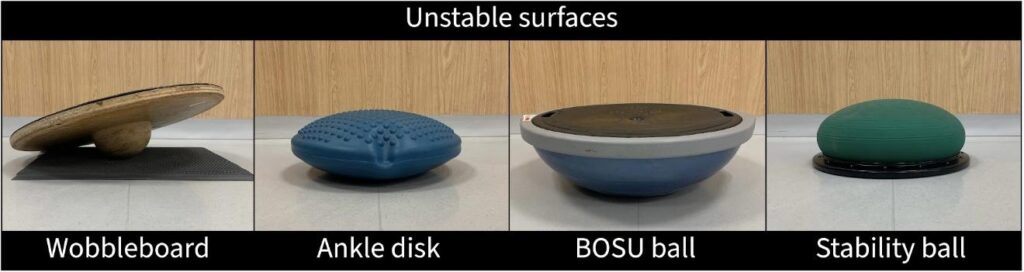
4. Use an unstable surface (especially interesting in climbing because it can reproduce the unsteady support of a crashpad!). Use a wobbleboard or an ankle disk if you can. A rolled towel or your crashpad can also do the trick.
5. Add a resistance band to increase the instability.
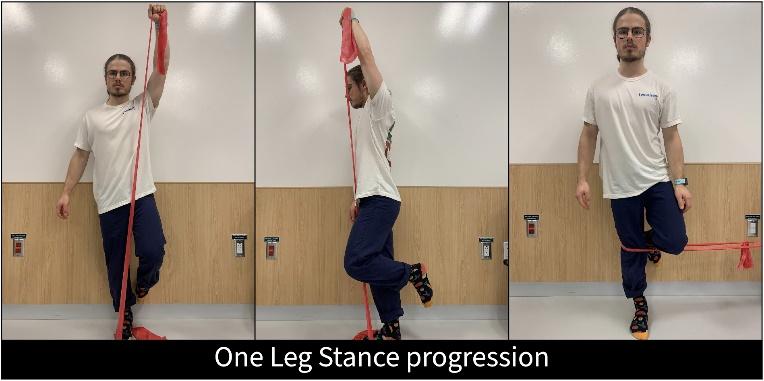
6. Take your climbing shoes on and try the previous steps.
7. Combine these steps to master balancing!
- Star Excursion (see Assessment)
Progression:
- Try the climbing-specific variant with the heel raised and knee bent.
- Close your eyes to challenge your senses. Open your eyes at your max to check your line. Tricky!
- Use an unstable surface.
- Add a resistance band to increase the instability.
- Take your climbing shoes on and try the previous steps.
- Combine these steps to master balancing!
- Position reproduction (see Assessment)
Progression:
- Try the climbing-specific variant with the heel raised and knee bent.
- Try to reproduce climbing positions as explained in the Assessment section.
- Close your eyes to challenge your senses.
- Use an unstable surface.
- Take your climbing shoes on and try the previous steps.
- Combine these steps to master balancing!
Muscle Strengthening
According to Han et al., strengthening exercises improve joint position sense in people with CAI11. So, grab your fingerboard and turn it into a toeboard! Jokes aside, let’s see what must be strengthened to improve ankle proprioception.
- Intrinsic muscles of the foot11 – 2-3 sets of 10 reps
These muscles are located under your feet, between the heel and the toes. They help to hollow the plantar arch, the curved area along the bottom of your foot running from the heel to the base of the toes, like the downturn of your aggressive pair of climbing shoes. They also curl the toes and stabilize the foot and ankle.
- In a seated position, shorten your foot by bringing the base of your toes towards the heel. There won’t be lots of movement apart from a slight hollowing of the plantar arch. Aim to feel your muscles working in the middle of your plantar arch. Avoid excessive toe-curling while doing it.
- If you don’t feel it, place your fingers into the plantar arch to palpate the contraction.
- Progress by trying it standing up, it may be harder with your body weight pressing on your foot!
4.You could also try barefoot climbing since it will necessarily target these tiny muscles more than climbing with shoes. Be careful if you try it on the rock, your feet may not have the same callus as your fingers! Also, check with your gym if they allow it.

- Calf raises – 2-3 sets of 10 reps
- Stand on one leg and lift your heel off the ground through your complete range of motion, in a controlled manner (e.g. with a good leg alignment).
- Progress by standing on a step to work in a wider range of motion.
- Add weights to your hands if too easy.
- Still easy? Perform an upper-body exercise with a resistance band or weights simultaneously for added challenge. Make it climbing-specific!


- Inversion (pointing your foot inwards) – 2-3 sets of 10 reps
- In a seated position, point your foot inwards, maintaining heel contact with the ground without moving the knee.
- This should be pretty easy, so progress the exercise by tying a resistance band to a stable chair or table leg, creating a loop for your foot.
- Use a stiffer resistance band to increase difficulty.

- Eversion (pointing your foot outwards) – 2-3 sets of 10 reps
- In a seated position, point your foot outwards, maintaining heel contact with the ground without moving the knee.
- This should be pretty easy, so progress the exercise by tying a resistance band to a stable chair or table leg, creating a loop for your foot.
- Use a stiffer resistance band to increase difficulty.
- Tibialis (Shin) Raises – 2-3 sets of 10 reps
- In a seated position, lift the front of your foot while keeping your heel on the ground. Ensure that the entire foot, not just the toes, is being lifted.
- This should be pretty easy, so progress the exercise by standing up with your back against the wall. Also, placing a rolled towel or a small step under your heels can make it harder.
- Add a resistance band or weights to increase difficulty.

Plyometric exercises12-18
Plyometrics are exercises performed at a relatively high speed. Huang et al. found they improve ankle joint position sense and calf muscle activation when landing on one leg. Their study also showed that plyometric training reduced the time for the muscles to adjust after landing, which is beneficial in climbing, especially in the context of a fall or when landing a dynamic movement. The possibilities of plyometrics are almost endless if you have some creativity, and it can easily be turned into a climbing-specific way. Here are some examples, with a progression to harder and more climbing-specific exercises.
- Jump squats (two feet → one foot)
- Jump up a step (progress the height, two feet → one foot)
- Lateral jumps (progress the distance, two feet → one foot)
- Jump/Drop down a step (progress the height, two feet → one foot)
- Zigzag hops (two feet → one foot)
- Agility ladder (be creative!)
Make it climbing-specific:
- Try these exercises with your climbing shoes on
- Try lateral jumps or agility ladder along the wall to mimic a dynamic movement on a boulder
- Set targets on the ground along the wall to mimic footholds and create different sequences of dynamic movements.
- Progress this last variant by making the targets smaller.
See a Doctor of Physical Therapy
Although this article gives you a good basis for working on ankle proprioception, it is no substitute for an appointment with a qualified healthcare worker, such as a physiotherapist. Proprioception training is well within the scope of physiotherapy. A professional can establish an individualized and evidence-based treatment plan for you. If you can, consult a physiotherapist who knows climbing and understands the sport’s demands.
Another reason to see a physiotherapist is to rule out the possibility of a more serious problem. For example, a recent ankle sprain would require treatment other than the exercises suggested in this article, or at least in the early stages of rehabilitation. The physiotherapist is also fully qualified to manage the injury in such a case.
In addition, physiotherapists can suggest certain modalities not covered in this article that could benefit you. These include bracing and taping, which are effective in some cases, and not in others according to the literature2-7-11. These modalities will be considered according to the context, scientific evidence, and the clinician’s experience. The variety and complexity of ankle taping also warrants consultation with a specialist, because it’s not as simple as an H-Tape for your pulley injury.
To end on a positive note, Schweizer et al. found that rock climbing could help improve ankle stability in cases of functional instability4. In other words, climbing is therapy! However, physiotherapy follow-up is essential to ensure the right dosage and progression. See you on the wall, future slab machine!

Author Bio
Lancelot (Lance) Guilbault is a third-year physical therapy student at the University of Montreal. He started climbing at six years old and has never stopped, focusing mainly on outdoor bouldering. Lance’s interest in physical therapy stems from his many sports, including climbing, backcountry skiing, hiking, and trail running.
In the future, Lance plans to help people of all ages, specializing in working with climbers to combine his passion for climbing with his practice as a physiotherapist.
Lance comes from Val-David, Quebec, Canada, where he started climbing, but now lives in Montreal for his studies. So, chances are you’ll find him at his local climbing gym, or in the woods with his hands on real rock.
You can also contact him via email (lancelot.guilbault18@gmail.com) or Instagram (@lancelot.guilbault).
References
- Han, J., Waddington, G., Adams, R., Anson, J., & Liu, Y. (2016). Assessing proprioception: a Critical Review of Methods. Journal of Sport and Health Science, 5(1), 80–90. https://doi.org/10.1016/j.jshs.2014.10.004
- Han, J., Anson, J., Waddington, G., Adams, R., & Liu, Y. (2015). The Role of Ankle Proprioception for Balance Control in relation to Sports Performance and Injury. BioMed Research International, 2015(1), 1–8. https://doi.org/10.1155/2015/842804
- Patrycja Bobowik, Świerczek, J., Jaskulski, K., Wiszomirska, I., & Gajewski, J. (2023). Evaluation of Balance and Muscle Strength of Upper and Lower Limbs in Rock Climbers. Polish Journal of Sport and Tourism, 30(4), 19–25. https://doi.org/10.2478/pjst-2023-0021
- Schweizer, A., Bircher, H-P., Kaelin, X., Ochsner, P. E. (2005). Functional ankle control of rock climbers. British Journal of Sports Medicine, 39(7), 429–431. https://doi.org/10.1136/bjsm.2002.001016
- Ehiogu, U. D., Jones, G., Johnson, M. I. (2022). Climbing Injury Rehabilitation. In V. Schöffl, I. Schöffl, C. Lutter & T. Hochholzer. Climbing medicine: A Practical Guide (pp. 261-284). Springer International Publishing.
- Chan, L. Y. T., Sim, Y. T. N., Gan, F. K., & Bin Abd Razak, H. R. (2022). Effect of chronic ankle instability on lower extremity kinematics, dynamic postural stability, and muscle activity during unilateral jump-landing tasks: A systematic review and meta-analysis. Physical Therapy in Sport, 55, 176–188. https://doi.org/10.1016/j.ptsp.2022.04.005
- Martin, R. L., Davenport, T. E., Fraser, J. J., Sawdon-Bea, J., Carcia, C. R., Carroll, L. A., Kivlan, B. R., & Carreira, D. (2021). Ankle Stability and Movement Coordination Impairments: Lateral Ankle Ligament Sprains Revision 2021. Journal of Orthopaedic & Sports Physical Therapy, 51(4), CPG1–CPG80. https://doi.org/10.2519/jospt.2021.0302
- Lin, J.-Z., Hung, M.-H., Ko, B.-J., & Lee, H.-J. (2024). Analysing lower limb motion and muscle activation in athletes with ankle instability during dual-task drop-jump. Sports Biomechanics, 1–15. https://doi.org/10.1080/14763141.2024.2369910
- Springer, B. A., Marin, R., Cyhan, T., Roberts, H., & Gill, N. W. (2007). Normative values for the unipedal stance test with eyes open and closed. Journal of Geriatric Physical Therapy (2001), 30(1), 8–15. https://doi.org/10.1519/00139143-200704000-00003
- Verhagen, E. A. L. M., van Mechelen, W., & de Vente, W. (2000). The Effect of Preventive Measures on the Incidence of Ankle Sprains. Clinical Journal of Sport Medicine, 10(4), 291–296. https://doi.org/10.1097/00042752-200010000-00012
- Han, J., Luan, L., Adams, R., Witchalls, J., Newman, P., Tirosh, O., & Waddington, G. (2022). Can therapeutic exercises improve proprioception in chronic ankle instability? a systematic review and network meta-analysis. Archives of Physical Medicine and Rehabilitation, 103(11). https://doi.org/10.1016/j.apmr.2022.04.007
- Huang, P.-Y., Jankaew, A., & Lin, C.-F. (2021). Effects of Plyometric and Balance Training on Neuromuscular Control of Recreational Athletes with Functional Ankle Instability: A Randomized Controlled Laboratory Study. International Journal of Environmental Research and Public Health, 18(10), 5269. https://doi.org/10.3390/ijerph18105269
- Schiftan, G. S., Ross, L. A., & Hahne, A. J. (2015). The effectiveness of proprioceptive training in preventing ankle sprains in sporting populations: A systematic review and meta-analysis. Journal of Science and Medicine in Sport, 18(3), 238–244. https://doi.org/10.1016/j.jsams.2014.04.005
- Akre, A., & Kumaresan, K. (2014). Comparison of a strengthening programme to a proprioceptive training in improving dynamic balance in athletes with chronic ankle instability (CAI). IOSR Journal of Sports and Physical Education, 1(5), 18–20. https://doi.org/10.9790/6737-0151820
- Akbar, S., Soh, K. G., Jazaily Mohd Nasiruddin, N., Bashir, M., Cao, S., & Soh, K. L. (2022). Effects of neuromuscular training on athletes physical fitness in sports: A systematic review. Frontiers in Physiology, 13(13). https://doi.org/10.3389/fphys.2022.939042
- Homaye Razavi, S. S., Shojaedin, S. S., Karimi, Z., & Barzeh, S. (2020). Effect of Six Weeks of Neuromuscular and Performance Balance Training on Balance and Performance Lower Extremity Climber Girls. Physical Treatments: Specific Physical Therapy Journal, 10(4), 213–220. https://doi.org/10.32598/ptj.10.4.431.3
- Huang, P.-Y., Chen, W.-L., Lin, C.-F., & Lee, H.-J. (2014). Lower Extremity Biomechanics in Athletes With Ankle Instability After a 6-Week Integrated Training Program. Journal of Athletic Training, 49(2), 163–172. https://doi.org/10.4085/1062-6050-49.2.10
- Disclaimer – The content here is designed for information & education purposes only and the content is not intended for medical advice.
- Disclaimer – The content here is designed for information & education purposes only and the content is not intended for medical advice.
Related Posts